
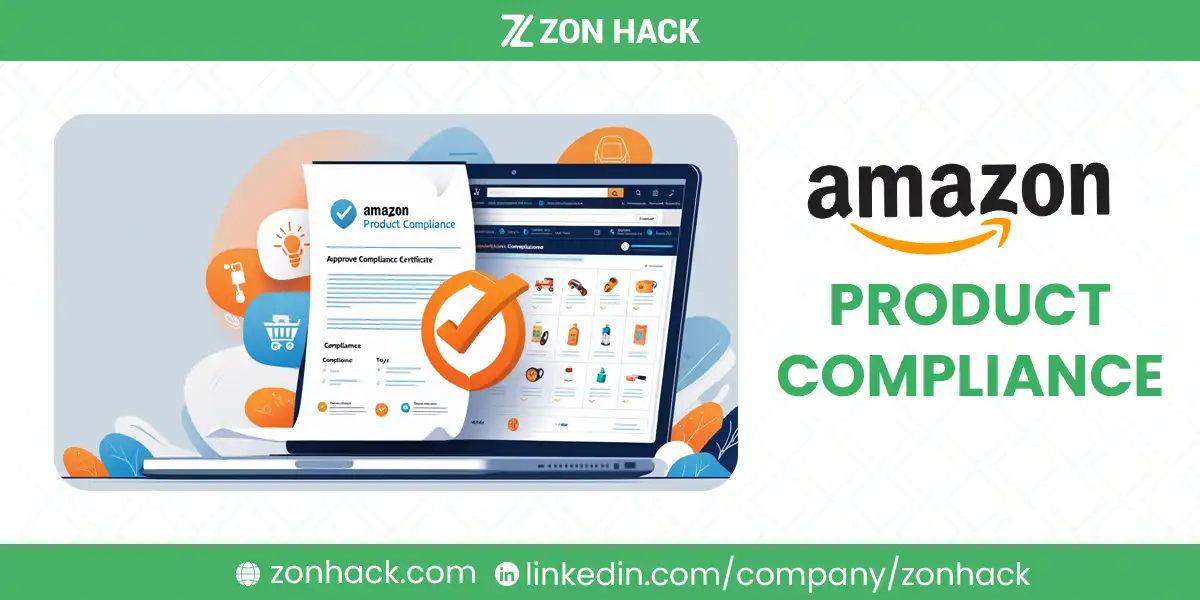
To add a product compliance certificate to Amazon listings, go to the compliance or document upload area in Seller Central, find the ASIN Amazon has flagged, and upload the specific document type it names. The critical part is matching the document to the request, because Amazon rejects the right paperwork submitted against the wrong requirement just as readily as it rejects missing paperwork.
Most rejected submissions we see are not non-compliant products. They are compliant products with a document that does not say what Amazon asked it to say, and the seller resubmits the same file three times before working that out.
This is general information for sellers, not legal or regulatory advice. Product compliance is technical and requirements change by market and category. An accredited testing laboratory issues the documents, and a regulatory specialist should confirm your position where the stakes justify it. We handle the Seller Central process for client accounts as an Amazon SPN Verified Partner; the testing itself belongs with a lab.
What Amazon actually asks for
The phrase compliance certificate covers several different documents. Sending the wrong one is the most common failure, so know which is which.
General Certificate of Conformity, or GCC. A self-issued declaration for general use consumer products subject to a consumer product safety rule, identifying the product, the rules it meets, the testing that supports it, and the responsible party. You issue it, based on testing.
Children’s Product Certificate, or CPC. The equivalent for children’s products, and it must be based on testing at a CPSC-accepted third party laboratory. Not self-certifiable in the way a GCC is. Our guide to children’s toy compliance covers what sits behind it, and our CPSIA tracking label guide covers the labeling obligation that accompanies it.
Safety Data Sheet, or SDS. Required for chemicals, batteries, aerosols, and other dangerous goods. Amazon uses these to classify products for storage and transport as well as for compliance, which is why they are requested so often. Our guide to the Amazon hazmat program covers that side.
Test reports from an accredited laboratory, showing the actual results rather than a summary. Accreditation to ISO 17025 is the usual expectation.
Declaration of Conformity for EU and UK markets, naming the manufacturer, the product, the standards applied, and the assessment route.
Marking evidence, such as photographs showing CE, UKCA, or FCC markings correctly applied to the product and packaging.
Read the request text carefully. Amazon usually names the exact document, and I’d rather spend five minutes on that sentence than three weeks on resubmissions.
When Amazon asks
At ASIN creation in regulated categories, before the listing goes live.
During category approval, as part of ungating.
In routine compliance sweeps, which arrive without warning and give you a deadline.
After a customer safety complaint or a regulator inquiry, which is the version with the shortest fuse.
When regulations change, since Amazon periodically re-requests documents against updated standards. This is worth planning for. A certificate that satisfied a request two years ago may reference a standard that has since been revised, which is exactly what happened when the mandatory US toy standard moved from one revision to the next.
When your listing makes a claim requiring substantiation, such as organic, flame resistant, or medical-grade.
Amazon has also tightened documentation requirements over time, extending compliance checks to more categories and to more stages of listing creation. Treat the direction of travel as one way. In our experience the sellers who suffer least are the ones who assembled the documents before anyone asked.
How to upload
- Find the request. It appears in Account Health, in Performance Notifications, or against the ASIN in Manage Inventory, depending on how it was raised.
- Read which document type is required, and for which specific ASIN or ASIN group.
- Check your document matches on product identity, the standard cited, the issuing body, and the date.
- Upload through the link in the request rather than through a general support case, so it routes to the right team.
- Wait. Review takes days rather than hours, and resubmitting while a review is open slows it down.
- Keep your own copy, filed by ASIN.
For multiple ASINs, Amazon provides a bulk compliance submission route: download the template, complete a row per ASIN with the document reference, and upload the file with the supporting documents. Worth using above roughly ten ASINs, and worth validating on two rows first, as our guide to common listing errors explains about flat files generally.
Why documents get rejected
Six reasons, in rough order of frequency.
Wrong document type. A test report submitted where a certificate was requested, or an SDS where a GCC was needed. The information may all be there and it is still the wrong document.
Product identity does not match. The model number, ASIN, or product description on the certificate differs from the listing. Even small discrepancies fail, and this is the one that most often surprises people.
The standard cited is outdated. Standards get revised. A certificate referencing a superseded revision needs reissuing rather than resubmitting.
Unrecognized laboratory. For children’s products in particular, testing must come from a CPSC-accepted lab. A report from a lab without the relevant accreditation is not usable however professional it looks.
Illegible or incomplete scans. Missing pages, cropped edges, unreadable stamps. Mundane, and it accounts for a real share of failures.
Expired or undated. No issue date, or a date outside the validity period for that document type.
When a submission is rejected, read the stated reason and fix that specific thing. Resubmitting an identical file hoping for a different reviewer wastes a week, and I have watched sellers do it four times.
Getting the documents in the first place
Ask your manufacturer first. Established factories producing for regulated markets usually hold current testing. Ask for the report and the accreditation details of the lab, not just a certificate.
Verify what you receive. Contact the laboratory named on the report and confirm it issued that document for that product. In our experience factory-supplied documentation against issuing labs on client products, and found discrepancies often enough to make it standard practice. A five minute email settles it and almost nobody sends one.
Commission your own testing where the factory cannot supply what you need, or where you are private labeling and the certificate needs to name you. Testing costs a fraction of a delisting.
Understand who the responsible party is. Putting your brand on a factory’s product generally makes you the responsible party, and the factory’s certificate in the factory’s name does not simply transfer. Our guide to finding wholesale suppliers covers documenting that chain.
Where we can and cannot help
Honest scope, since compliance attracts overpromising.
What an agency can do: identify which document Amazon is asking for, check your existing paperwork against the request, coordinate with your supplier and laboratory, manage the Seller Central submission and any appeal, and keep the documentation organized against future requests. That resolves most cases where the product is genuinely compliant and the paperwork is not.
What an agency cannot do: certify your product, substitute for accredited laboratory testing, give legal advice, or make a genuine safety concern go away. The legal responsibility stays with you regardless of who files the paperwork.
If your problem is documentary and procedural, that sits within our account management and sourcing work, and our guide to suppressed listings covers recovering a listing already taken down. If the question is genuinely regulatory, the answer is a lab and a specialist.
FAQ
What is a product compliance certificate on Amazon?
A document proving a product meets applicable safety standards. Depending on the product it may be a General Certificate of Conformity, a Children’s Product Certificate, a Safety Data Sheet, a laboratory test report, or a Declaration of Conformity for EU and UK markets.
How do I upload a compliance certificate to Amazon?
Open the compliance request in Account Health, Performance Notifications, or against the ASIN in Manage Inventory, confirm which document type is required, and upload through the link in the request rather than through a general support case so it routes correctly.
Can I submit compliance documents for multiple ASINs at once?
Yes. Amazon provides a bulk compliance submission template where you complete a row per ASIN with the document reference and upload the supporting files. Validate on two rows before running the full file.
Why did Amazon reject my compliance document?
Most often because the document type was wrong for the request, the product identity on the certificate did not match the listing, the standard cited has since been revised, or the testing laboratory was not accredited for that standard. Illegible scans account for a surprising share too.
What is the difference between a GCC and a CPC?
A General Certificate of Conformity covers general use consumer products and is self-issued based on testing. A Children’s Product Certificate covers children’s products and must be based on testing at a CPSC-accepted third party laboratory, so it cannot be self-certified in the same way.
Do I need my own certificate if my supplier has one?
Usually yes if you are private labeling, since putting your brand on the product generally makes you the responsible party and the factory’s certificate names the factory. Verify any supplied document directly with the issuing laboratory before relying on it.
Last updated: August 29, 2026. This is general information for sellers, not legal or regulatory advice. Amazon’s documentation requirements, accepted document types, and submission processes change, as do the underlying safety standards. Seller Central carries Amazon’s current requirements, and an accredited laboratory should advise on your specific products.