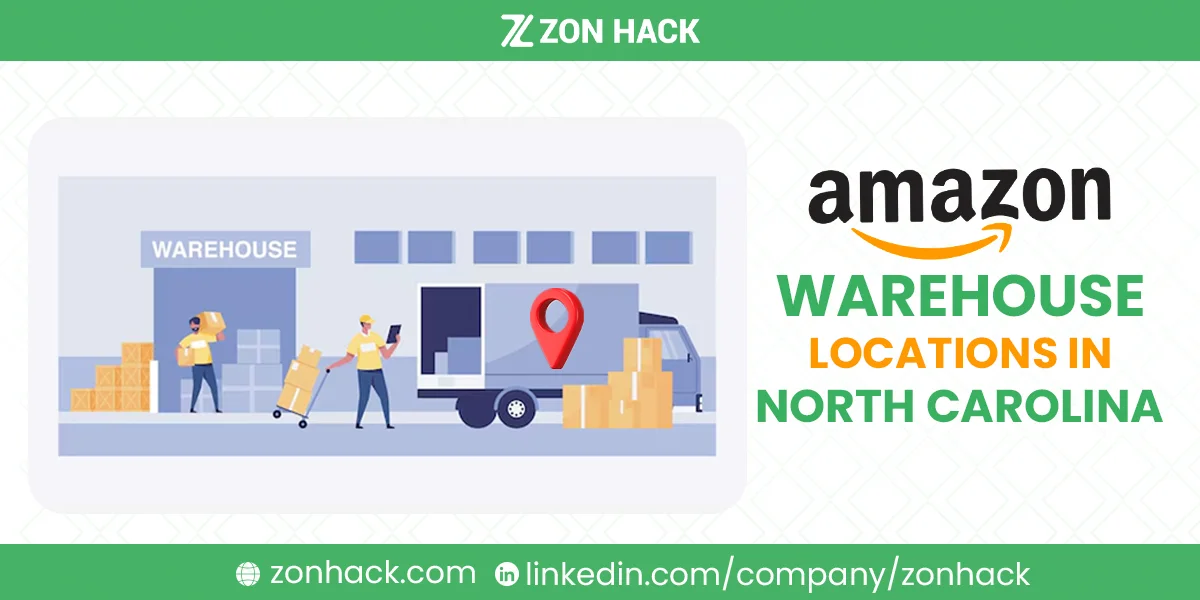
North Carolina’s Amazon network is spread across three metropolitan areas rather than concentrated
in one, and Mecklenburg County holds three times as many facilities as any other county in the
state. Charlotte is the center of gravity, with the Triangle and the Triad running their own
smaller operations.
The short version in numbers: 25 North Carolina facilities on record, 21 of
them carrying a published facility code, spread across 4
distinct facility types. The full breakdown is below.
Looking up a code you saw on a tracking page? Every North Carolina facility we have on record is in the table below with its code, address, and type. Search this page for your code. If it is not here, it is most likely a building in a neighboring state, because parcels cross state lines routinely on the way to you and I’d not read that as a problem.
Every Amazon facility in North Carolina
25 facilities, of which 21 have a published code: 10 fulfillment centers, 8 delivery stations, 5 distribution centers, 2 sortation centers.
| Code | Address | ZIP | Type | County |
|---|---|---|---|---|
| DLT1 | 3830 Parrott Dr, Charlotte, NC | 28214 | Delivery Station | Mecklenburg |
| DLT6 | 1610 Old Greensboro Rd, Kernersville, NC | 27284 | Delivery Station | Forsyth |
| DLT7 | 6495 Franz Warner Pkwy, Whitsett, NC | 27377 | Delivery Station | Guilford |
| DRT4 | 394 Fanning Fields Rd, Mills River, NC | 28759 | Delivery Station | Henderson |
| DRT7 | 1201 N Greenfield Pkwy, Garner, NC | 27529 | Delivery Station | Wake |
| DRT8 | 3830 Parrott Dr, Charlotte, NC | 28214 | Delivery Station | Mecklenburg |
| WNC6 | 1005 Dunn Rd, Fayetteville, NC | 28312 | Delivery Station | Cumberland |
| (not listed) | North Carolina 68, Kernersville, NC | 27284 | Delivery Station | Forsyth |
| CLT2 | 10240 Old Dowd Rd, Charlotte, NC | 28214 | Distribution Center | Mecklenburg |
| RDU2 | 2150 US-70 BUS, Smithfield, NC | 27577 | Distribution Center | Johnston |
| (not listed) | 8419 Todd Rd, Charlotte, NC | 28214 | Distribution Center | Mecklenburg |
| (not listed) | 4851 Jones Sausage Rd, Garner, NC | 27529 | Distribution Center | Wake |
| (not listed) | 11901 Nations Ford Rd, Pineville, NC | 28134 | Distribution Center | Mecklenburg |
| CLT3 | 6500 Davidson Hwy, Concord, NC | 28027 | Fulfillment Center | Cabarrus |
| CLT4 | 8000 Tuckaseegee Rd, Charlotte, NC | 28214 | Fulfillment Center | Mecklenburg |
| CLT6 | Carolina Logistics Dr, Pineville, NC | 28134 | Fulfillment Center | Mecklenburg |
| GSO1 | 1656 Old Greensboro Rd, Kernersville, NC | 27284 | Fulfillment Center | Forsyth |
| HCL9 | 12220 Carolina Logistics Dr, Pineville, NC | 28134 | Fulfillment Center | Mecklenburg |
| RDU1 | 4851 Jones Sausage Rd, Garner, NC | 27529 | Fulfillment Center | Wake |
| RDU4 | 6309 Bragg Blvd, Fayetteville, NC | 28303 | Fulfillment Center | Cumberland |
| RDU5 | 1805 TW Alexander Dr, Durham, NC | 27703 | Fulfillment Center | Durham |
| RDU9 | 3875 Senator Ralph Scott Pkwy, Mebane, NC | 27302 | Fulfillment Center | Alamance |
| SNC3 | 125 National Wy, Durham, NC | 27703 | Fulfillment Center | Durham |
| CLT5 | 1745 Derita Rd, Concord, NC | 28027 | Sortation Center | Cabarrus |
| CLT9 | 3620 Reeves Ridge Dr, Charlotte, NC | 28214 | Sortation Center | Mecklenburg |
Addresses are compiled from public listings. Amazon opens, closes, and repurposes buildings
continually, and no facility on this list accepts visitors or takes calls about individual
parcels, which is why we do not publish site phone numbers.
The North Carolina codes people look up most
- RDU2 is a distribution center at 2150 US-70 BUS in Smithfield.
- RDU9 is a fulfillment center at 3875 Senator Ralph Scott Pkwy in Mebane.
- RDU4 is a fulfillment center at 6309 Bragg Blvd in Fayetteville, roughly 60 miles from Raleigh.
- CLT2 is a distribution center at 10240 Old Dowd Rd in Charlotte.
The RDU codes are the instructive ones. All three carry Raleigh-Durham’s airport prefix and none is in
Raleigh, which is the clearest illustration on this page of why the letters describe a region rather
than a town.
Charlotte, the Triangle, and the Triad
Mecklenburg County leads decisively, with Forsyth and Wake counties behind it, then Durham and
Cabarrus. Charlotte holds the most sites by town, followed by Kernersville, Pineville, Garner,
Durham, and Concord.
The three clusters do different jobs. Charlotte is a distribution play, sitting on I-85 and I-77
with a major cargo airport, and Pineville and Concord extend it in either direction. The Triad, around
Winston-Salem and Kernersville in Forsyth County, sits further up I-40 and serves the middle of the
state. The Triangle, meaning Raleigh, Durham, and Garner, serves the eastern half.
There is a wrinkle worth knowing. Codes beginning RDU turn up a long way from Raleigh. One sits in
Mebane, between the Triad and the Triangle. Another sits in Fayetteville, roughly 60 miles south of
Raleigh. RDU is Raleigh-Durham’s airport code, and Amazon uses it as a regional marker rather than a
municipal one. In our experience that catches people out more in North Carolina than in most states.
The coast and the mountains are thinner. Wilmington, Asheville, and the Outer Banks are served across
longer distances, and delivery promises stretch accordingly.
What it means when your parcel is at one of these
The facility type tells you roughly how far along your parcel is, and I’d argue that is the
single most useful thing on this page after the addresses themselves.
A fulfillment center holds inventory, so a parcel there has usually not been packed for you yet.
A sortation center handles parcels that are already packed, grouping them by destination region.
A delivery station is the last building your parcel sees before it goes onto a van, which means
it is close to you and close to arriving. Our guide to the different types of Amazon warehouse
covers what happens inside each, and sortation center versus fulfillment center
covers the pair people confuse most.
A word on the codes themselves. Amazon has never published its facility naming scheme, so
every decoder you find online is inference rather than documentation. One pattern does hold up
reasonably well: a leading D usually means a delivery station. Beyond that I’d read the type column
above rather than the letters, because the exceptions are common enough to mislead you.
If the parcel has stopped moving entirely, our guide to what a carrier delay means
covers how long to wait before it is worth doing anything, and our guide to
a disappeared order covers the case where
the order itself has vanished from your account rather than the parcel from the network.
If your code is not on this list
Searched and found nothing? That happens often, and I’d read it as unremarkable. The
possibilities are few.
The building sits in a neighboring state. The single most common answer. Parcel networks are
built around drive times rather than state lines, and in our experience a cross-border scan worries
people who have no reason to be worried.
The site is newer than this page. Amazon commissions buildings faster than any list is updated,
so recent codes are frequently absent.
It is not an Amazon code at all. Contracted delivery partners and third-party logistics providers
run their own identifiers, which look similar and are not the same thing.
A character was misread somewhere. Zero versus O, one versus I, five versus S. When I have run
down a code that seemed impossible, a misread character was often the whole story.
Whichever applies, the sensible move is to wait for the next tracking update rather than to
investigate the address.
Other Amazon buildings you may see in tracking
Five other kinds of Amazon building turn up in tracking often enough to be worth naming, and
none of them behave like the ones above.
Air hubs move freight between regions by aircraft rather than picking orders, which is why a
parcel can appear hundreds of miles from both its origin and its destination without anything having
gone wrong. Receive centers, sometimes labeled cross-docks, take bulk shipments from
manufacturers and break them apart for distribution; nothing there is destined for a customer yet.
Amazon Warehousing and Distribution sites hold bulk stock upstream and replenish fulfillment
centers automatically, which matters to importers and is largely unknown among smaller merchants.
Returns centers grade what customers send back. And third-party partner sites are buildings
Amazon uses without owning, which is why some addresses look nothing like a warehouse.
I’d not read too much into seeing one. They are ordinary stages in a long chain.
Visiting, calling, and collecting
Worth stating plainly, because it comes up constantly: you cannot visit any of these
sites. Fulfillment centers, sortation centers, and delivery stations admit no members of the
public, hand out no parcels, and run no inquiry desk. Amazon Locker and Amazon Hub Counter locations
are the designated collection points and are unrelated to the facilities in this table.
Facility phone numbers, where other lists publish them, are the same trap. When I have followed one
up it reached a switchboard with no visibility of orders at all, so the useful route is Amazon
customer service rather than the building.
What North Carolina offers a seller
Two things, one about position and one about the port.
Charlotte’s position on I-85 is genuinely useful. The corridor runs from Atlanta to Richmond and
onward to the Northeast, which puts a large share of the fast-growing Southeast within a short drive.
That is why the network holds so much capacity there, and it is why Amazon routes inventory to the
Carolinas readily.
The Port of Wilmington is smaller than Savannah or Charleston, and I’d not build an import
strategy around it unless you have a specific reason. For most sellers importing into the Southeast,
Savannah and Charleston remain the practical entry points, and our
Georgia page covers why Savannah in
particular has grown so quickly.
As everywhere, placement is not a seller decision. Send to Amazon assigns your inbound
destination, and only fulfillment centers hold seller inventory.
A note on how much weight to put on this list. I’ve found it helps to say plainly what a
page like this can and cannot do.
Everything here comes from public listings rather than from Amazon, which means it trails the real
network. Closed buildings linger; new ones take a while to appear. The type column carries whatever
those listings recorded, and in our experience that is usually accurate rather than always accurate.
Use the page to identify a code and to understand what stage your parcel has reached. Do not use it
to count Amazon’s footprint exactly, and I’d be wary of anyone who claims to.
FAQ
How many Amazon warehouses are in North Carolina?
The complete list with codes, addresses, and types appears in the table above. The network spreads
across Charlotte, the Triad, and the Triangle rather than concentrating in one metro.
Which North Carolina county has the most Amazon facilities?
Mecklenburg County, around Charlotte, which holds roughly three times as many as any other county in
the state. Forsyth and Wake counties follow.
Why are RDU facilities not in Raleigh?
Because RDU is used as a regional marker rather than a municipal one. RDU-prefixed sites appear in
Smithfield, Mebane, and Fayetteville, the last roughly 60 miles from Raleigh, which shows that
facility letters point at a region rather than at an address.
What is CLT2 and where is it?
CLT2 is a distribution center at 10240 Old Dowd Rd in Charlotte. CLT is Charlotte Douglas
International Airport’s code.
Why is Amazon delivery slower in Asheville or the Outer Banks?
Because the mountains and the coast are served across longer distances from the three inland metro
clusters. That stretches delivery promises, and it is a function of geography rather than a gap in the
network.
Should sellers import through the Port of Wilmington?
Usually not. Wilmington is considerably smaller than Savannah or Charleston, which remain the
practical Southeast entry points for most sellers importing containerized goods.
Last updated: August 30, 2026. Compiled from public listings; Amazon’s facility network changes
continually and this page will lag it. Facilities do not accept visitors or handle parcel
inquiries. For warehouse employment, Amazon’s own hiring site carries current openings and is
the only accurate source.