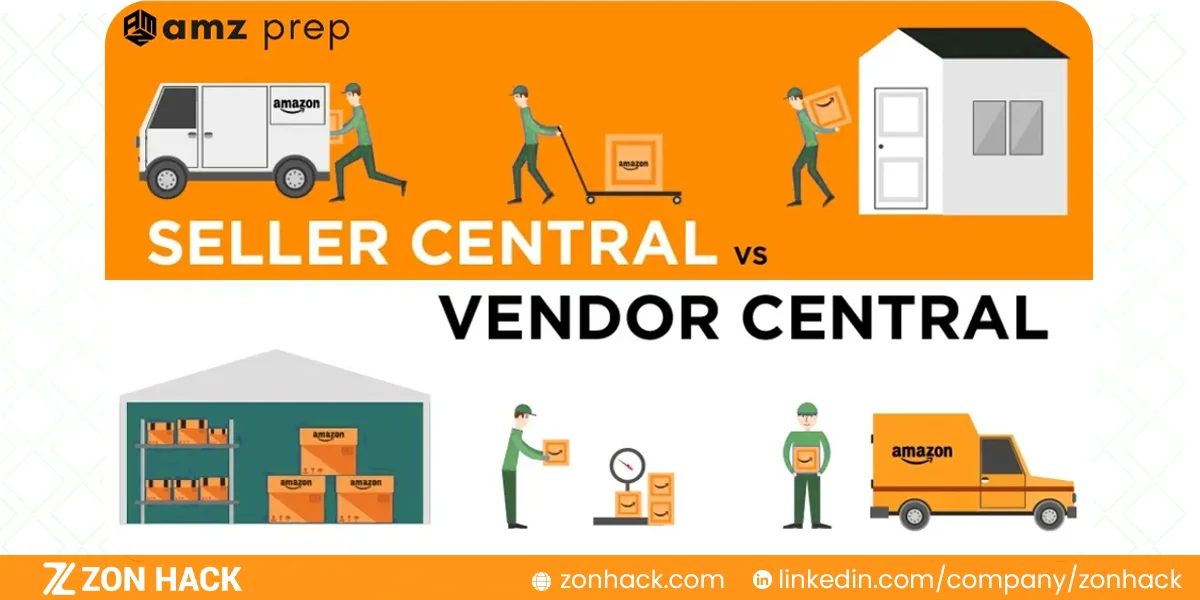
The Vendor Central vs Seller Central choice comes down to one question: do you sell to Amazon, or on Amazon? Vendor Central makes you a wholesale supplier, with Amazon buying your stock and setting the retail price, and it is invitation-only. Seller Central makes you the retailer, keeping inventory ownership and pricing control, and anyone can register. For most brands today, Seller Central is the stronger choice.
Vendor Central (1P) makes you a supplier. Amazon buys your inventory wholesale, then sets the retail price, owns the customer relationship, and handles everything downstream. It is invitation-only.
Seller Central (3P) makes you the retailer. You keep ownership of inventory until a customer buys, you set your own prices, and you carry the operational work. Open to anyone.
Here is the part most comparisons soften: for most brands, Seller Central is now the better platform, and plenty of vendors have deliberately moved from 1P to 3P. Amazon’s own strategy has shifted toward the third-party marketplace, and the control you surrender in Vendor Central is difficult to get back. I’ll explain where 1P still genuinely wins, because it does in specific cases.
We manage accounts on both models for clients. We tested the economics of each against real catalogs, and in our experience the trade-offs below matter far more than the feature lists everyone publishes.
Vendor Central vs Seller Central: side by side
| Vendor Central (1P) | Seller Central (3P) | |
|---|---|---|
| Access | Invitation only | Open registration |
| Your role | Supplier to Amazon | Retailer on Amazon |
| Who sets retail price | Amazon | You |
| Who owns inventory | Amazon, after purchase | You, until sale |
| Fulfillment | Amazon | Your choice: FBA or FBM |
| Payment | Purchase orders, net terms | Disbursements every two weeks |
| Customer data | Limited | Fuller access via reports |
| Advertising | Broad access | Broad access, with Brand Registry |
| A+ Content | Yes | Yes, with Brand Registry |
| Chargebacks | Yes, and they add up | No equivalent |
That table matters less than the two asymmetries underneath it: price control and cash flow. Everything else is detail.
The margin picture, roughly
Numbers make this concrete. Take a product retailing at $40:
- On Seller Central (3P): you collect $40, minus roughly 15% referral fee ($6), minus fulfillment of perhaps $5, leaving around $29 before your cost of goods and advertising.
- On Vendor Central (1P): you invoice Amazon at wholesale, commonly somewhere near half of retail, so roughly $20, minus chargebacks and allowances that in our experience frequently reach 5% to 10% of invoice value.
Those are illustrative rather than universal, and your category’s referral rate and negotiated terms move both figures. But the shape holds: 3P generally leaves more gross margin, and 1P converts that difference into simplicity and volume predictability. Whether that trade is worth it is genuinely a business decision, not an obvious answer.
Seller Central: the strengths
You control price. The big one, in my view. Hold consistency across your other retail channels. Respond to competitors. Protect your positioning. Vendors watch Amazon discount their goods below their own MAP and can do almost nothing about it.
Better data. The Seller Central reports plus Brand Analytics give you sessions, conversion, and search query performance per product. That is the raw material for every optimization decision, and 1P visibility is thinner.
Fulfillment flexibility. FBA for Prime speed. FBM where you want control, or where FBA economics simply fail. MCF to serve other channels from the same pool.
Inventory control. You decide what to manufacture, hold, and allocate. For brands running limited production, that matters enormously.
Faster feedback loops. Change a price today. A title today. An image today. Under 1P, catalog edits route through Amazon’s own processes at Amazon’s own pace.
And the costs
Fees. Referral fees on everything, plus FBA fulfillment and storage, or your own shipping costs on FBM. Our pick and pack fee guide covers modeling that properly.
All the work is yours. Listings, keywords, advertising, inventory planning, customer messages, account health. Real hours, and the reason account management exists as a service.
Operational risk. Stockouts. Suppressed listings. Suspensions. Amazon absorbs more of that under 1P, which is a genuine point in its favor.
Vendor Central: the strengths
Simplicity. Ship against purchase orders. Invoice. Done. No listing work, no ad account, no customer service queue. For a manufacturer lacking ecommerce capability, I’d call that simplicity worth real money.
“Ships from and sold by Amazon.” Some shoppers trust it more, and the effect is genuine even if smaller than vendors assume.
Volume purchase orders. Large POs make production planning predictable, and factories genuinely prefer working that way.
Retail relationship. For brands whose business is wholesale, 1P fits existing muscle memory: you already know how to sell to buyers.
And the costs, which are underrated
You lose pricing power. Amazon sets retail. Discount aggressively enough and your other channels notice, then your positioning suffers. I have watched that unravel a wholesale relationship.
Chargebacks and deductions. Late shipments, ASN errors, packaging non-compliance, co-op allowances. These accumulate into meaningful margin erosion, and vendors are consistently surprised by the total.
Wholesale margins. You sell at wholesale, not retail. The gross margin difference against a well-run 3P operation is often substantial.
Net payment terms. Net 30, 60, or 90 rather than the biweekly disbursements 3P sellers get. For a growing brand, that cash flow difference is not a footnote; it decides how fast you can reorder.
Thin data and slow changes. Less shopper insight, and every catalog amendment moves at Amazon’s pace rather than yours.
So which should you choose?
Choose Seller Central if you want price control, better data, faster iteration, and higher gross margin, and you are willing to do the operational work or pay someone to. That describes most brands, and it is what I recommend by default.
Choose Vendor Central if you are a manufacturer with no ecommerce capability and no intention of building one, your business model is genuinely wholesale, your volumes are large enough that PO predictability outweighs margin, and you can live with Amazon controlling retail price.
Consider a hybrid if you are already 1P: many brands keep core lines on Vendor Central while running new products, variations, or bundles through Seller Central to retain control and gather data. It is a common and sensible arrangement.
One thing worth knowing before you accept an invitation: moving from 1P back to 3P is harder than moving the other way. Amazon may keep buying and reselling remaining stock, your catalog history sits under Amazon’s control, and rebuilding as a 3P seller takes time. I would not accept a Vendor Central invitation without modeling the 3P alternative properly first, and in our experience the model usually favors 3P.
Getting either one right
Both models reward the same underlying work: strong listings, real keyword coverage, and content that converts. Whichever platform you land on, the 6 pillars of listing optimization apply, Brand Registry unlocks A+ Content and analytics on both, and advertising performance still depends on the listing underneath it.
If you are weighing the decision for a real brand with real numbers, an account audit will model both paths against your actual margins, which beats deciding from a comparison table, including this one.
FAQ
What is the difference between Vendor Central and Seller Central?
Vendor Central makes you a wholesale supplier: Amazon buys your inventory and sets the retail price. Seller Central makes you the retailer: you keep inventory ownership, set your own prices, and handle operations. Vendor Central is invitation-only; Seller Central is open.
Is Vendor Central better than Seller Central?
For most brands, no. Seller Central offers price control, better data, faster changes, and higher gross margin. Vendor Central suits manufacturers with no ecommerce capability, genuinely wholesale business models, and volumes where purchase-order predictability outweighs margin.
Can I use both Vendor Central and Seller Central?
Yes, and many brands do. A common hybrid keeps established lines on Vendor Central while running new products, variations, or bundles through Seller Central to retain pricing control and gather customer data.
How do I get invited to Amazon Vendor Central?
Amazon’s vendor managers extend invitations, typically to brands showing strong sales, distinctive products, or established retail presence. You cannot apply directly, and being invited does not mean accepting is the right decision.
Who sets the price on Vendor Central?
Amazon does. As a 1P vendor you sell at wholesale and Amazon determines retail pricing, including discounts that may fall below the pricing you maintain in other channels.
What are Vendor Central chargebacks?
Deductions Amazon applies for compliance failures such as late shipments, incorrect advance shipping notices, or packaging errors, alongside negotiated allowances. They accumulate and materially reduce vendor margin, which is why they deserve modeling before you sign.
Last updated: August 27, 2026. Amazon’s vendor terms, fee structures, and program availability change; confirm current details with Amazon directly before committing to either model.