
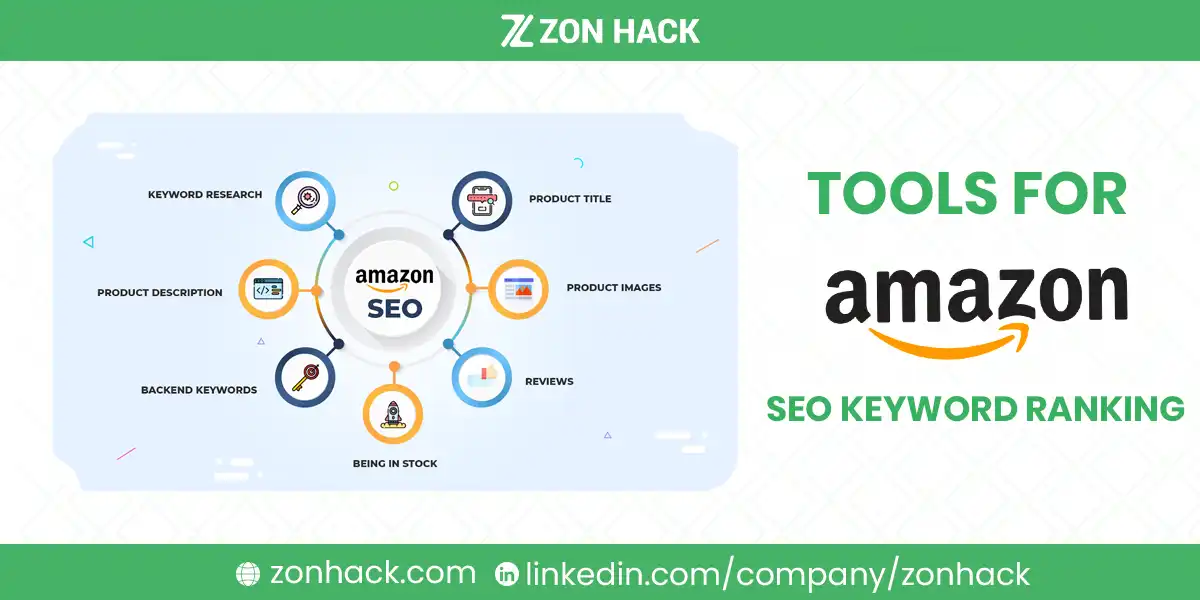
Tools for Amazon SEO keyword ranking do four distinct jobs, and most sellers buy a suite to get one of
them. Work out which job you need before looking at a single product page, because the answer is
frequently “none of them yet”.
The four jobs:
| Job | What it answers | Do you need a paid tool? |
|---|---|---|
| Discovery | What terms exist that I am missing | Sometimes |
| Demand sizing | Which of those terms people actually search | No, Brand Analytics does it |
| Rank tracking | Where I sit for a term, over time | Yes, if you track more than a handful |
| Competitor reverse lookup | What terms a rival’s ASIN ranks for | Yes, this is the genuine gap |
Two of those four Amazon gives you free, and better than a third party can, because Amazon’s numbers
are Amazon’s numbers rather than estimates. In our experience sellers pay monthly for estimates of data
already sitting in their own account.
We name no winner and publish no prices. An earlier version of this page listed ten tools with specific
monthly fees. Those figures were stale within months and we could not stand behind them, so they are gone.
What follows is how to choose.
Before buying tools for Amazon SEO keyword ranking, use the free data
Three sources. Exhaust them first. Buy nothing until you have.
Your advertising search term report. The actual phrases shoppers typed before clicking your ads. No
tool can improve on this because it is not an estimate, it is your product’s real demand. I’d read it
before any purchase decision.
Brand Analytics, if you have Brand Registry. Search Frequency Rank tells you how much demand a term
carries, and the top clicked ASINs tell you where that demand goes. Our guide to
Amazon Search Frequency Rank covers reading it, and
remember rank 1 is the most searched term, so lower is better.
Amazon autocomplete and the ASIN index check. Autocomplete surfaces real phrasing. Searching a term
together with an ASIN tells you whether that product indexes for it. Our guide to
finding competitors’ ranked keywords
covers the free method properly, including the Brand Analytics limitation that most guides get wrong.
What free will not give you: rank tracking over time, and a bulk reverse lookup on somebody else’s
ASIN. Those two are the honest case for paying.
A decision path, if you want one line
The four-job framing is useful. It also still leaves you choosing, so here is a shortcut.
One product, category you know, no Brand Registry. Buy nothing yet. Mine autocomplete, read three
competitor listings, read your own search term report once you are advertising. I’d revisit in a quarter.
One product, category you know, Brand Registry. Buy nothing. Brand Analytics covers demand and
Search Query Performance covers your own share. In our experience this describes a large share of sellers
who are paying subscriptions.
A handful of products, and you are making listing changes you want to measure. Buy rank tracking only.
That history is the thing you genuinely cannot reconstruct after the fact, and I’d start it before the
next listing edit rather than after.
Twenty or more products, or an unfamiliar category. A suite starts making sense, chiefly for discovery
breadth and bulk reverse lookup. Buy a month, run the five-term test below, and cancel without
sentimentality if it fails.
Competitive research as a recurring job. Reverse lookup is the one capability with no free equivalent
at scale, so this is the clearest paid case on the page. I’d still treat every number it produces as an
estimate.
A pattern I keep seeing. Sellers buy the suite at product one and use a tenth of it for two years.
The subscription becomes invisible, nobody audits it, and the free data in their own account stays unread.
When I have asked people to open their search term report during a call, it was frequently the first time.
Job one: discovery
Finding phrasings that never occurred to you. Breadth, essentially.
What a tool adds: breadth and speed. A large seed-expansion database surfaces phrasings you would not
reach by hand, and I’d value that most in a category you have never sold in.
What it cannot supply: judgment about whether a phrase genuinely describes your product. A tool hands
you 400 candidates and perhaps 40 survive scrutiny, so the winnowing remains yours. That winnowing is where
the value hides, in our experience, and no subscription performs it.
When it is worth paying: a catalog above roughly 20 products, or a category you do not know well. In our experience the threshold is lower than sellers hope and higher than vendors claim.
When it is not: one product in a category you understand. An hour of autocomplete mining and reading
competitor titles gets you most of it. I’d do that first regardless.
Job two: demand sizing, where you should not pay
The job vendors market hardest. Also the one they perform worst.
Search volume figures from any vendor are estimates, extrapolated from scraped result pages. Amazon
publishes absolute search volumes to nobody. Not to agencies, not to vendors, not to sellers.
Brand Analytics gives you Amazon’s own ranking of demand. Not a volume, a rank, which is less
satisfying and considerably more reliable. I’d take an authoritative rank over an estimated number every
time.
Where the estimates mislead: they tend to be directionally sensible and numerically confident, which is
a bad combination. A seller builds a forecast on a number nobody stands behind, and I’ve watched that forecast survive into a board deck.
If you lack Brand Registry, this is a genuine gap and an estimate is better than nothing. It is also
another argument for getting Brand Registry, which is free once you hold a trademark. Our guide to
Brand Registry versus Brand Approval covers the
enrollment route, including IP Accelerator for a pending mark.
Job three: rank tracking
The clearest case for paying. Also the one sellers consider least.
What it does: logs your organic position for nominated terms, daily, indefinitely. That accumulated
history is precisely the asset you cannot reconstruct retrospectively.
Why it matters: it is the only way to attribute a listing change to a ranking movement. Without it you
have a before-and-after feeling rather than evidence, and in my experience feelings are generous to whoever made the change.
What to check before buying: how many terms and ASINs the plan covers, whether it tracks your
marketplace, how often it samples, and whether you can export the history. The export question is the one
people forget, and I’d ask it before signing.
A free substitute at small scale: check manually, weekly, for 5 terms, and record it in a
spreadsheet. Tedious and entirely workable for one product. Above 5 terms I’d pay rather than persevere.
How to track keyword ranking on Amazon
Amazon has no report that shows your organic position for a keyword. Its own data explains why you rank where you do; a tracker or a spreadsheet records where you rank. I’d use both.
- Pick 5 to 10 terms. Take them from your search term report or, with Brand Registry, from Search Query Performance, which shows impressions, clicks, cart adds and purchases for each query against the whole market.
- Record a baseline before you change anything. Search each term in a private window, then note the page and position of your ASIN.
- Check weekly, same day, same time. Rank moves through the day. Consistency beats frequency.
- Write down every listing change, price change and ad change beside the numbers. Without that log, a rank movement can’t be explained.
- Move to a paid tracker once you’re past 5 terms or a single product. Our guide to tracking organic rank for an ASIN compares the options. That’s the whole method, and it works.
For ads, the Sponsored Products search term impression share report shows your share and rank of ad impressions for each term. It covers ads only, not organic position. Useful, but different.
The best free Amazon keyword research tools
Free doesn’t mean weak here. Most of the best keyword data is Amazon’s own:
| Free tool | What it gives you | Who can use it |
|---|---|---|
| Sponsored Products search term report | The exact phrases shoppers typed before clicking or buying through your ads | Anyone running ads |
| Amazon Search Terms report (Brand Analytics) | Search frequency rank, plus the top 3 clicked products with their click and conversion share | Brand Registry |
| Search Query Performance (Brand Analytics) | Query volume, impressions, clicks, cart adds and purchases for your brand or ASIN | Brand Registry |
| Amazon search autocomplete | Real shopper phrasing, in order of what Amazon suggests | Everyone |
| ZonHack keyword index checker | Whether a specific ASIN is indexed for a keyword | Everyone |
Each source answers a distinct question. Autocomplete reveals vocabulary. Frequency rank hints at popularity. Click and conversion share expose which competing listings actually win the sale, week after week, in the categories you care about. The index checker confirms eligibility. Combined, the gaps show up fast.
My view: a seller with Brand Registry and a running ad campaign already has better keyword data than most paid tools can estimate. Paid tools earn their place for discovery in a new category and for reverse lookups on competitors, which is the next job. Start free.
Job four: competitor reverse lookup
The genuine capability gap. Amazon supplies nothing whatsoever here.
What it does: you enter a competitor’s ASIN and get an estimated list of terms it ranks for. Amazon
has no equivalent, and no free workaround does this in bulk.
The caveats are substantial. Estimated, over-reported, and padded with phrases the ASIN nominally
occupies at position 200. The export demands filtering before it signifies anything at all.
The free alternative operates one term at a time. Search a phrase alongside their ASIN and observe
whether they surface. Reliable. Slow. Perfectly adequate for a handful.
When to pay: competitive research across many ASINs, or entering an unfamiliar category where you need
the lay of the land quickly. I’d buy a month rather than a year, and in our experience the annual discount is rarely worth the commitment.
How to evaluate one in a trial
Four tests. The first eliminates most candidates outright.
Does it find the terms you already know you rank for? Take five terms you are certain about. If the
tool misses them, its estimates for terms you do not know are worthless. This single test is the most
useful thing you can do with a trial, and in our experience almost nobody runs it.
Does it cover your marketplace properly? Coverage outside the US is frequently thinner than the
marketing suggests. Test with your own products, in your own storefront, and I’d not accept a demo account as evidence.
Can you export? If your history is locked inside the tool, you are renting your own data.
Is the interface something anybody will genuinely open each month? A platform nobody signs into is a
recurring invoice masquerading as capability. I’d prefer a plain instrument somebody actually consults.
What no tools for Amazon SEO keyword ranking will do for you
Four limits. Internalize them before spending anything.
Decide relevance. Only you know what your product actually is. Every tool over-reports, the filtering remains
yours, and in our experience that filtering is the whole skill.
Repair a conversion problem. Where relevant visitors decline to purchase, additional phrases alter
nothing whatsoever. Our guide to
improving your product detail page covers
that half, and I’d start there.
Overcome a review deficit. Frequently a competitor outranks you on accumulated sales history and review
volume, and no amount of keyword labor narrows that distance. This is the constraint I’d weigh most
heavily, and in my experience it explains more stubborn rankings than vocabulary ever does.
Place the keywords. Knowing a term is not using it. Our guides to
Amazon backend keywords and
how many keywords you can use cover where each word belongs
and what every field limit actually is.
If you would rather have the research, the tracking, and the listing work handled together, that sits
inside our
listing optimization service. We have
optimized 10,000+ listings, and we are an Amazon Ads partner and an Amazon SPN Verified Partner.
FAQ
What tools do I need for Amazon keyword ranking?
It depends which of four jobs you need: discovery, demand sizing, rank tracking, or competitor reverse
lookup. Amazon gives you demand sizing free through Brand Analytics and gives you real demand data free
through your advertising search term report, so the genuine paid cases are rank tracking and reverse
lookup.
Are Amazon keyword search volume estimates accurate?
They are inferred from scraped data, because Amazon does not publish search volumes to anyone. Brand
Analytics instead gives Amazon’s own Search Frequency Rank, which is a rank rather than a volume, and an
authoritative rank is more reliable than a confident estimate.
Do I need a paid tool to find Amazon keywords?
Not for a single product in a category you understand. An hour of autocomplete mining, reading competitor
titles and bullets, and reading your own advertising search term report gets you most of the way. Paid
discovery earns its place above roughly 20 products or in an unfamiliar category.
How do I track keyword ranking on Amazon?
Pick 5 to 10 terms, record your ASIN’s position for each in a private browser window, and check weekly at the same time, logging every listing change. Amazon has no organic rank report, so past a handful of terms a paid rank tracker saves time.
What is the best free Amazon keyword tool?
Your own advertising search term report, which reports the phrases shoppers actually typed rather than an
estimate, followed by Brand Analytics if you have Brand Registry, then Amazon autocomplete and the
ASIN-plus-keyword index check.
How should I test an Amazon SEO tool during a trial?
Give it five terms you already know you rank for. If it misses them, its estimates for terms you do not
know are worthless. Then check marketplace coverage with your own products, confirm you can export your
history, and ask whether anyone will open it monthly.
Why does my product not rank despite good keywords?
Frequently because the competitor ahead of you has sales history and review count rather than better
keywords, or because relevant traffic reaches your listing and does not convert. Neither is fixable with
keyword tools, so diagnose conversion before buying more research.
Last updated: October 17, 2026. Tool pricing, features, and marketplace coverage change frequently, and
Brand Analytics report names and eligibility change over time; check current terms directly. An earlier
version of this page listed ten named tools with specific monthly prices and feature claims that we could
not substantiate or keep current; those have been removed in favor of how to choose.