
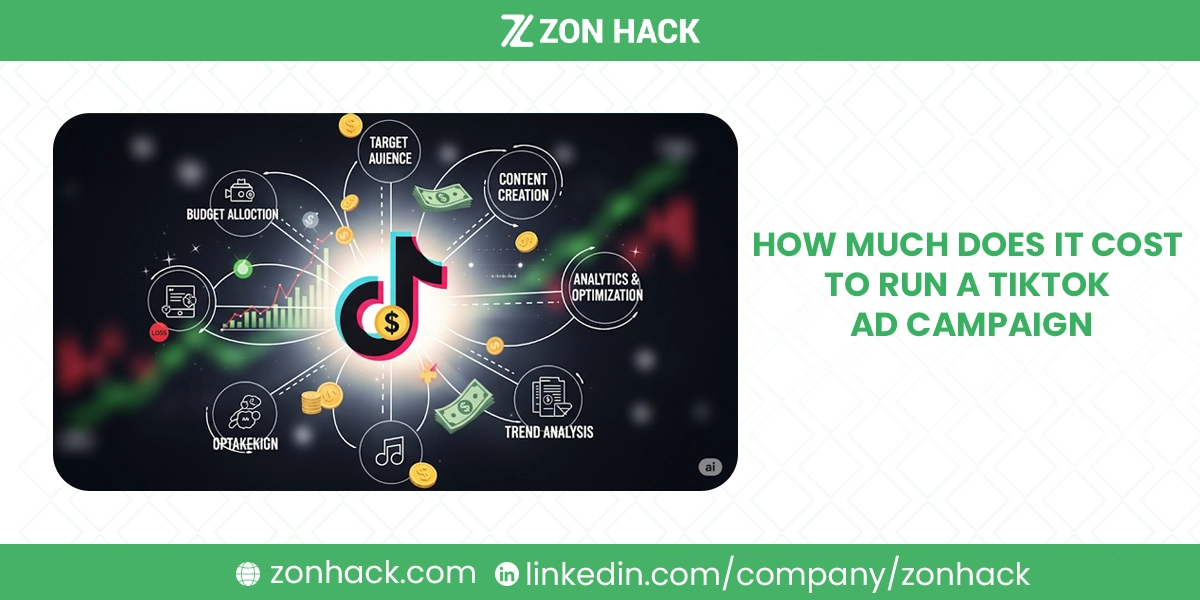
A TikTok ad campaign costs more than the media budget suggests, because the platform enforces daily minimums and the creative is a recurring expense rather than a one-off. TikTok Ads Manager sets a floor on campaign and ad group daily budgets, and a campaign that produces one video and runs it for three months will underperform regardless of how well it is targeted.
I’d budget for three things: the media spend, the minimums that constrain how small you can test, and a continuous supply of creative. The third is the one that surprises people.
TikTok ad campaign cost starts with the platform minimums
TikTok Ads Manager enforces daily budget floors at both campaign and ad group level. I’ve found they catch people out, because they are the practical constraint on testing cheaply.
Historically these have sat around $50 per day at campaign level and $20 per day per ad group, with lifetime budget equivalents. Those figures have moved and differ by account type and region, so check the current floors in your own Ads Manager before planning.
The consequence matters more than the number. If you want to test three ad groups you are committing to a meaningful daily spend from day one, which makes TikTok a harder place to dip a toe than a search platform where a few dollars a day gets you real data.
I’d plan a genuine test at $1,000 to $3,000 over three to four weeks rather than trying to learn anything from $200. Below that you are buying noise.
What the auction typically costs
CPM and CPC vary enormously by country, audience, objective and season. I’d hold any published figure loosely and treat it as an order of magnitude rather than a quote.
Broadly, TikTok has tended to deliver cheaper impressions than the established social platforms and more variable conversion, which is the usual shape for a younger ad marketplace. Cost per thousand impressions is often low. Cost per acquisition is where the variance lives.
The thing that moves your cost most is not targeting. It is creative. On TikTok the algorithm distributes based heavily on engagement, so an ad that performs like content gets cheap distribution and an ad that performs like an advertisement gets expensive distribution. That relationship is stronger here than on most platforms.
The creative cost nobody budgets
This is the real answer to what a TikTok ad campaign costs, and it is not a line in Ads Manager.
TikTok creative fatigues fast. An ad that works for two weeks stops working, not because the audience is exhausted but because the format rewards freshness. Running one video for a quarter is not a strategy, it is a slow failure.
So the ongoing cost is a creative pipeline: several videos a month, in the native vertical format, that look like something a person made rather than something a brand approved. Options and rough costs:
- Make it yourself. Free, and viable, and the format genuinely rewards unpolished work.
- Creator or UGC content. Commonly a few hundred dollars per video depending on the creator’s following and usage rights.
- Spark Ads, which promote an existing organic post, either yours or a creator’s with permission. Often the best-performing format because it starts with something that already earned engagement.
- Agency production. Several thousand dollars, and frequently the wrong choice, because polished production can perform worse here than an authentic phone video.
That last point is genuinely counterintuitive and I’d emphasize it. On most channels better production helps. On TikTok, production values that signal “advertisement” can actively raise your cost.
Whether this makes sense for an Amazon seller
Being direct, since ZonHack works mostly with Amazon sellers and I’d rather give an honest answer than a flattering one.
It usually does not, and the reason is attribution. Sending TikTok traffic to an Amazon listing means you pay for the click and then lose visibility into what happened. Amazon Attribution helps and it is imperfect. You end up spending on a channel you cannot measure cleanly, which is a poor combination.
There is a second problem specific to Amazon. Traffic that does not convert lowers your conversion rate, and conversion rate is the dominant input to Amazon ranking, as our guide to Amazon product ranking factors sets out. Poorly targeted external traffic can therefore make your organic position worse while costing you money.
Where it does make sense: if you run your own store alongside Amazon, where you control the tracking. If your product is visually demonstrable and benefits from being shown in motion. If your buyer skews young. Or if you sell through TikTok Shop, where the transaction stays on the platform and attribution is clean.
For a seller whose entire business is Amazon, I’d spend the same money inside Amazon Ads first, where the attribution is direct and the search term report tells you exactly what worked.
The question behind the question
When somebody asks what a TikTok ad campaign costs, they are usually asking something else: whether it will work for them. The cost is knowable and the answer to the real question depends on three things.
Can you produce creative continuously? Not once. Continuously, at several videos a month, indefinitely. If the honest answer is no, the media budget is irrelevant because the campaign will decay and you will conclude the platform does not work when actually the pipeline did not exist. I’d treat this as the qualifying question and answer it before looking at any cost figure.
Can you measure the outcome? If the destination is a page you control, yes. If it is an Amazon listing, only partially, and you will be making budget decisions on incomplete evidence for as long as you run it.
Is your buyer there? TikTok’s audience has broadened considerably and it still skews younger than most marketplaces. A product bought predominantly by people over fifty is a harder fit, and no budget fixes an audience mismatch.
Answer those three honestly and the cost question resolves itself. Two yeses and a maybe means run a proper test at the figures above. Two noes means the money belongs somewhere else, and I’d say that plainly rather than quoting a CPM that makes it sound accessible.
In our experience the sellers who do well on TikTok are the ones already making video for other reasons, and I’ve found that pattern holds regardless of budget. The platform rewards a habit more than a budget, which is an unusual thing for an ad channel and the single most useful thing to understand about it.
A realistic TikTok ad campaign cost, end to end
If you decide to test properly, here is the shape I’d use. In our experience anything meaningfully leaner than this produces an opinion rather than a result.
Media: $1,000 to $3,000 over three to four weeks, enough to clear the daily minimums across two or three ad groups and accumulate readable data.
Creative: three to six videos minimum for the test. Either your own time or a few hundred dollars each for creator content.
Tracking setup: hours rather than dollars, but do not skip it. The pixel, the events, and Amazon Attribution links if the destination is a listing.
Time: a month before judging. The algorithm needs a learning period, and reading results in week one measures the learning rather than the outcome.
Total realistic entry: $1,500 to $4,000 for a test that produces an actual answer. Anything materially below that produces an opinion.
What I would watch
Three numbers, and I’d read them in this order.
Cost per acquisition against your contribution per unit. Not CPM, which is easy to make look good. If a sale contributes $9 and acquisition costs $14, the campaign is not working however impressive the reach.
Creative performance spread. If one video vastly outperforms the others, that tells you more than the campaign average and it is the thing to build on.
The decay curve. How many days before a winning ad’s cost per acquisition starts climbing? That number sets how fast your creative pipeline has to run, and in our experience it is shorter than people expect.
FAQ
What is the minimum budget for a TikTok ad campaign?
TikTok Ads Manager enforces daily minimums at both campaign and ad group level, historically around $50 and $20 respectively, with equivalents for lifetime budgets. Figures change and differ by region and account type, so check the current floors in your own Ads Manager.
How much should I budget to test TikTok ads properly?
Roughly $1,000 to $3,000 in media over three to four weeks, plus three to six videos. That clears the daily minimums across a couple of ad groups and accumulates enough data to read. Substantially less than that produces noise rather than an answer.
Why do TikTok ads stop working after a couple of weeks?
Creative fatigue. The platform distributes based heavily on engagement and rewards freshness, so a single video’s performance decays regardless of audience size. Running one ad for a quarter is a slow failure rather than a strategy.
Does expensive production help TikTok ad performance?
Often the opposite. Polished production can signal “advertisement” and raise your distribution cost, while a competent phone video that reads as native content gets distributed more cheaply. This runs against the pattern on most other ad channels.
Should Amazon sellers advertise on TikTok?
Usually not, because sending traffic to an Amazon listing costs you the click and most of the visibility into what happened afterwards. Poorly converting external traffic can also lower your conversion rate, which is the dominant input to Amazon ranking.
When does TikTok advertising make sense for ecommerce?
When you control the destination and therefore the tracking, such as your own store or TikTok Shop. Also when the product is visually demonstrable and gains from being shown in motion, and when your buyer skews young enough for the audience to match.
Last updated: September 12, 2026. TikTok’s minimum budgets, ad formats, auction costs and available products change frequently and differ by region, so verify current figures in TikTok Ads Manager rather than relying on the ranges here. ZonHack is an Amazon Ads verified partner and an Amazon SPN Verified Partner, and our advertising work is focused on Amazon, so treat the comparison here as informed but interested.