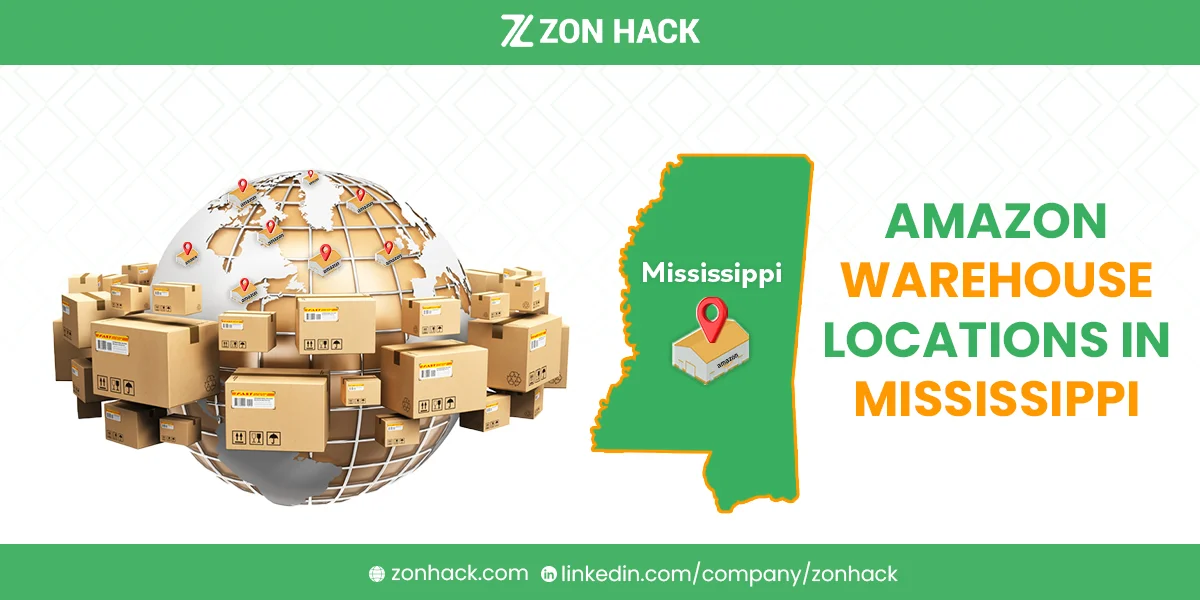
Mississippi’s Amazon network is small, and the single most useful thing to know about it is not on
any map of the state. The facilities in northern Mississippi carry Memphis codes, because
Byhalia, Olive Branch, and Horn Lake sit inside the Memphis metropolitan area, which happens to
straddle the Tennessee state line.
If you searched a MEM code and landed here, that is why.
The short version in numbers: 6 Mississippi facilities on record, 3 of
them carrying a published facility code, spread across 3
distinct facility types. The full breakdown is below.
If you are trying to identify a code from your tracking, start with the table below. It lists every Mississippi facility we hold, alongside its address and type. Search the page for your code. Codes that do not appear here generally sit just over a state line, and I’d treat that as ordinary rather than alarming.
Every Amazon facility in Mississippi
6 facilities, of which 3 have a published code: 4 fulfillment centers, 1 distribution center, 1 sortation center.
| Code | Address | ZIP | Type | County |
|---|---|---|---|---|
| (not listed) | 1000 W 63rd St, Hattiesburg, MS | (not listed) | Distribution Center | Forrest |
| JAN1 | 1978 MS-22, Canton, MS | (not listed) | Fulfillment Center | Madison |
| MEM2 | 191 Norfolk Southern Way, Byhalia, MS | (not listed) | Fulfillment Center | Marshall |
| (not listed) | 1615 Commerce Pkwy, Horn Lake, MS | (not listed) | Fulfillment Center | Desoto |
| (not listed) | 850 Gateway Global Dr, Byhalia, MS | (not listed) | Fulfillment Center | Marshall |
| MEM6 | 11505 Progress Wy, Olive Branch, MS | (not listed) | Sortation Center | Desoto |
Addresses are compiled from public listings. Amazon opens, closes, and repurposes buildings
continually, and no facility on this list accepts visitors or takes calls about individual
parcels, which is why we do not publish site phone numbers.
The Mississippi codes people look up most
Mississippi is the clearest case in this cluster of codes crossing a state line.
- MEM2 is a fulfillment center at 191 Norfolk Southern Way in Byhalia, in Marshall County.
- MEM6 is a sortation center at 11505 Progress Wy in Olive Branch, in DeSoto County.
- JAN1 is a fulfillment center at 1978 MS-22 in Canton, near Jackson. JAN is Jackson’s airport
code. - MEM8 is the single most searched code landing on this page and it is not in Mississippi at
all. It is a Memphis-area facility on the Tennessee side of the line, which our
Tennessee listing covers.
The MEM prefix on Byhalia and Olive Branch is not an error. Those towns are part of the Memphis
metropolitan area, and Amazon’s naming follows the region rather than the state.
The Memphis metro reaches into Mississippi
DeSoto and Marshall counties lead, level with each other, with Madison and Forrest holding one each.
By town, Byhalia holds two, then Canton, Horn Lake, Olive Branch, and Hattiesburg.
DeSoto and Marshall counties are functionally Memphis. Olive Branch and Horn Lake are inner
suburbs of the Memphis metro; Byhalia is a short distance further out along I-269. The facilities
there exist because Memphis is one of the great freight hubs of the world, and northern Mississippi
offered land that Shelby County did not. The state line is administratively real and operationally
almost irrelevant.
That is why our listing shows facilities in Byhalia and Olive Branch carrying MEM prefixes. It is
one of the clearest examples anywhere of a facility code describing a metropolitan region rather than
a state.
The rest of the state is thinly covered. Canton, near Jackson, serves central Mississippi. Hattiesburg
covers the south. Between and around them, distances are long and delivery promises run longer than in
the northern corner. The Gulf coast is served partly from Louisiana and Alabama, so out-of-state
codes there are routine.
What it means when your parcel is at one of these
The type of building tells you how far along the journey is. I’ve found that single distinction
resolves most of the anxiety people arrive with.
A fulfillment center is where inventory sits, so your order has probably not been packed. A
sortation center only ever sees packed parcels and groups them by region. A delivery station
is the last building before the van, so a parcel there is normally close to home. Our guide to the different types of Amazon warehouse
covers what happens inside each, and sortation center versus fulfillment center
covers the pair people confuse most.
One caveat about the codes. The naming scheme has never been published by Amazon, so
decoders you find elsewhere are guesswork dressed as documentation. A leading D does reliably tend to
indicate a delivery station. Past that, I’d trust the type column in the table rather than trying to
read meaning into three letters, since I’ve found the exceptions turn up constantly.
If the parcel has stopped moving entirely, our guide to what a carrier delay means
covers how long to wait before it is worth doing anything, and our guide to
a disappeared order covers the case where
the order itself has vanished from your account rather than the parcel from the network.
If your code is not on this list
If you have searched this page and come up empty, that is a normal outcome rather than a
problem, and I’d resist the urge to read anything into it. Four explanations cover almost every case.
It is a facility in an adjoining state. By far the most likely. Distribution networks ignore
state boundaries entirely, and in our experience people are far more surprised by this than the
logistics justify.
It opened after this listing was compiled. Amazon adds buildings constantly and any published
list trails reality by some margin.
It is a partner code, not an Amazon one. Contracted carriers and third-party logistics firms
issue their own facility identifiers that will never appear here.
The characters were misread. Zero and O, one and I, five and S all trip people up. I’ve found
this explains a surprising share of codes that appear not to exist.
In every one of those cases the useful response is the same: let the tracking update rather than
chase the building.
Other Amazon buildings you may see in tracking
A handful of other facility types show up in tracking, and knowing them removes a lot of
needless worry.
Air hubs exist to fly freight between regions rather than to pick orders, so a scan at one can
place your parcel somewhere that looks like a detour and is not. Receive centers, or cross-docks,
accept bulk freight direct from manufacturers and break it down for distribution, so nothing there
belongs to a customer yet. Amazon Warehousing and Distribution sites store bulk stock upstream
and replenish fulfillment centers automatically. Returns centers grade returned merchandise.
Third-party partner sites are leased or contracted buildings rather than Amazon-owned ones.
When I have followed an unusual scan back, it has almost always been one of these rather than a
fault.
Visiting, calling, and collecting
A point people frequently test before believing: these are not places you can visit.
Fulfillment centers, sortation centers, and delivery stations take no visitors, release no parcels
over a counter, and staff no desk that can discuss an individual order. Collection happens at Amazon
Locker and Amazon Hub Counter locations instead, which have nothing to do with the buildings above.
Phone numbers deserve the same treatment. Some facility lists publish them; I’d skip them entirely.
They reach switchboards with no access to order records, and in my experience the call achieves
nothing that Amazon customer service would not have handled immediately.
Northern Mississippi is a real logistics location
Worth taking seriously, because it is easy to dismiss a small state and be wrong about this one.
DeSoto County is a substantial distribution market in its own right, precisely because it is
Memphis without Memphis property costs. Third-party logistics and prep capacity has grown there for
the same reason Amazon built there, and for a seller wanting inventory prepped near the center of the
overnight air network, it is a genuine option worth pricing.
The air network is the point. Memphis anchors overnight freight in the United States, and being
adjacent to it matters more for speed-sensitive goods than being in a larger state elsewhere. Our
guide to shipping options for Amazon sellers
covers how that fits with FBA.
Hurricane exposure applies to the southern half of the state between June and November, and it affects
delivery reliability for Gulf coast addresses. Our guide to
what a carrier delay means covers why that
damages your On-Time Delivery Rate regardless of cause.
Placement remains Amazon’s decision, and only fulfillment centers hold seller inventory.
How to read this page, and what it cannot tell you. I’d rather set expectations than have
you draw the wrong conclusion from a table.
The list is compiled from public listings, so it lags Amazon’s actual network and always will. A
building that closed last quarter may still appear; one that opened last month probably does not.
The type column reflects what those listings recorded, and in our experience it is right far more
often than not, without being infallible.
What the page is genuinely good for is identifying a code you have in front of you and working out
roughly where your parcel sits in the chain. What it is not good for is counting Amazon’s real estate
precisely, and I’d treat any site claiming an exact national figure with some suspicion.
FAQ
How many Amazon warehouses are in Mississippi?
Few. The complete list with codes and addresses appears in the table above, concentrated in DeSoto and
Marshall counties in the north, with single sites near Jackson and Hattiesburg.
Why do Mississippi warehouses have Memphis MEM codes?
Because Byhalia, Olive Branch, and Horn Lake sit inside the Memphis metropolitan area, which straddles
the Tennessee state line. Amazon’s facility codes follow the metropolitan region rather than the state
boundary.
Where is MEM8?
MEM8 is the most searched code reaching this page and it is not in Mississippi. It is a Memphis-area
facility on the Tennessee side of the state line.
Which Mississippi county has the most Amazon facilities?
DeSoto and Marshall counties, level with each other, both in the northern corner within the Memphis
metropolitan area. Madison and Forrest counties hold one each.
Why is Amazon delivery slower in southern Mississippi?
Because the state is thinly covered outside the northern corner. Canton serves central Mississippi and
Hattiesburg covers the south, with long distances between them, and the Gulf coast is served partly
from Louisiana and Alabama.
Is northern Mississippi useful to Amazon sellers?
Yes, more than its size suggests. DeSoto County is a substantial distribution market because it offers
Memphis adjacency without Memphis property costs, which matters for goods where overnight air freight
speed is valuable.
Last updated: August 30, 2026. Compiled from public listings; Amazon’s facility network changes
continually and this page will lag it. Facilities do not accept visitors or handle parcel
inquiries. For warehouse employment, Amazon’s own hiring site carries current openings and is
the only accurate source.