
Amazon sort center vs fulfillment center comes down to one difference: a fulfillment center
stores products and packs orders, while a sort center never opens a parcel at all. A fulfillment
center holds seller inventory and can keep it for months. A sort center handles sealed, labeled
parcels and moves them on within 24 hours, usually within 6 to 12.
Everything else follows from that. If your tracking shows a fulfillment center, your order has
probably not been packed yet. If it shows a sort center, it is packed, it is moving, and it is being
grouped with other parcels heading toward your region. The sort center scan is the better news of
the two, because it means the slow part is finished.
Amazon sort center vs fulfillment center: the short answer
- Fulfillment center: stores inventory, picks it, packs it, ships it. Your order starts here.
- Sort center: receives packed parcels, groups them by destination, sends them on. Nothing is
opened, nothing is stored. - For a shopper: a fulfillment center scan is early, a sort center scan is later and better.
- For a seller: only the fulfillment center is ever relevant to your inventory.
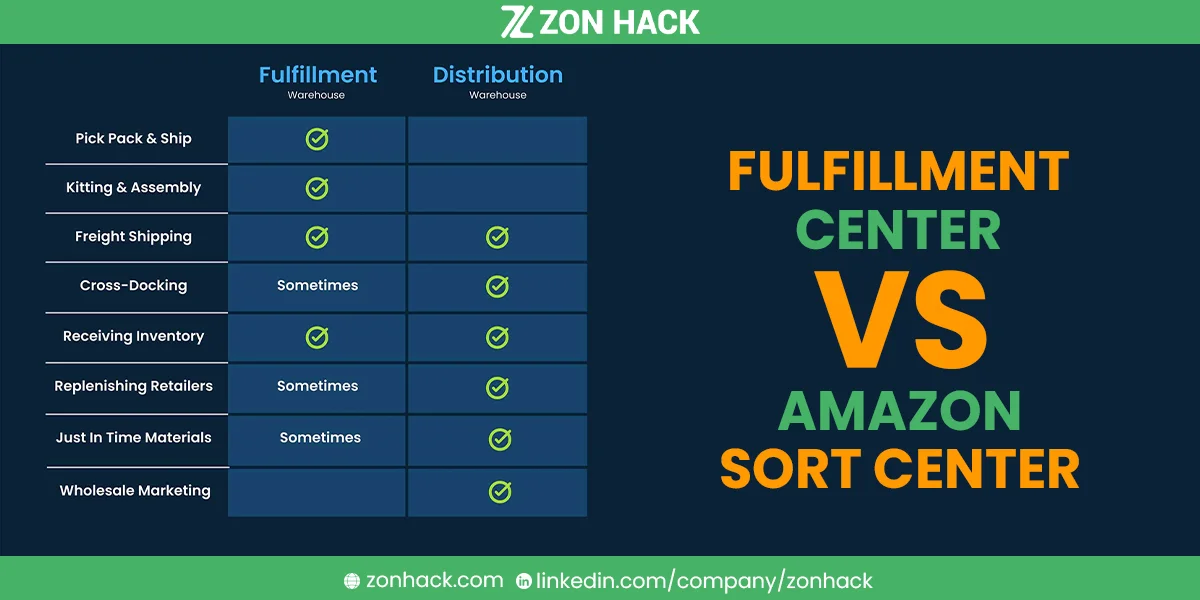
| Fulfillment center | Sort center | |
|---|---|---|
| Holds seller inventory | Yes | No |
| Opens or packs parcels | Yes | Never |
| What arrives | Bulk stock from sellers | Sealed, labeled parcels |
| What leaves | Packed customer orders | The same parcels, sorted by region |
| Typical time inside | Days to months for stock, hours for an order | Hours |
| Number in the network | Fewer, much larger | More, smaller |
| Staff roles | Receive, stow, pick, pack, ship | Sort, load |
| What a scan means for you | Not packed yet | Packed and on its way |
What happens inside a fulfillment center
Five stages, in order, and your order passes through all of them.
Receive. Seller inventory arrives, is checked against a shipment plan, and is accepted or refused.
Stow. Units are placed into storage locations. Amazon deliberately scatters identical products
rather than grouping them, because a short walk to one item beats a long walk to a shelf of the same
thing.
Pick. When you order, a worker or robotic system retrieves your specific unit.
Pack. The item is boxed or bagged, labeled, and sealed. This is the moment it becomes a parcel.
Ship. It leaves for the next stage in the network, which is frequently a sort center.
The stages are covered station by station in our guide to
the positions at an Amazon warehouse.
What happens inside a sort center
Two stages, and neither involves your product directly.
Sort. Parcels arrive already sealed and labeled. They are scanned and grouped by destination
region, increasingly by automated systems.
Load. Grouped parcels are loaded for onward travel, usually toward a delivery station.
That is genuinely all of it. Nothing is stored. Nothing is opened. Nothing is picked. Most parcels
clear a sort center in under 24 hours and frequently in 6 to 12, which is why the building can be a
fraction of the size of a fulfillment center while handling a comparable number of items in a day, and
why sorting capacity scales by adding more small buildings rather than by making any one of them
larger. Think airport transfer hall, not shop.
The size difference follows from that. A fulfillment center can exceed 1,000,000 square feet because
it has to hold assortment. A sort center needs only enough floor to move parcels across it, so the
network runs more of them at a fraction of the size.
Why the distinction matters more than it sounds
Three reasons, and the second one costs people money.
For a shopper, it tells you where you are in the process. A fulfillment center scan means the
slow stage is still ahead. A sort center scan means it is behind you. People worry in exactly the
wrong order. In our experience the enormous building simply sounds more significant than the small
one, so a scan at the place where nothing much is going to happen to your parcel reads as reassuring
while the scan that actually signals progress goes unnoticed.
For a seller, it decides whether a building is relevant at all. Only fulfillment centers hold your
inventory. A state can be full of sort centers and offer you nothing, and sellers who count Amazon
buildings in a region and conclude they have that many storage options have misread the network
entirely. This is the most common misconception we encounter.
For anyone reading a facility list, it explains the inconsistency. Third-party listings label
buildings loosely, and the same site can appear as a fulfillment center on one list and a distribution
center on another. The type matters; the label is unreliable.
Warehouse, distribution center, fulfillment center: the general picture
Worth doing properly, because this is the follow-up question almost everyone asks and most answers
collapse the terms together.
These are industry terms describing what a building does, and they sit on a spectrum from storage at
one end to speed at the other.
| Building | Primary job | Who it ships to | Typical outbound | Stock dwell time |
|---|---|---|---|---|
| Warehouse | Store goods | Whoever collects | Bulk, infrequent | Long, months |
| Distribution center | Store and move on | Retailers, businesses | Pallets and cases | Medium, weeks |
| Fulfillment center | Pick, pack, ship orders | Individual consumers | Single parcels, constant | Short, days to weeks |
| Sortation center | Sort packed parcels | Delivery stations, carriers | Sorted parcel streams | Hours |
| Delivery station | Load vans | Your door | Individual parcels | Hours |
The clearest way to hold it: a warehouse is mostly shelves. A distribution center is shelves with
a loading dock and a schedule. A fulfillment center is a machine for turning single orders into
single parcels. Sortation centers and delivery stations store nothing at all, they just move parcels
closer to you.
Warehouse versus fulfillment center is the comparison sellers ask most, and the practical
difference is who the customer is. A warehouse serves businesses collecting in bulk. A fulfillment
center serves consumers buying one unit, which requires completely different labor, layout and
software. That is also why third-party warehousing usually costs less per unit stored and more per
order shipped.
Where Amazon fits into those terms
Amazon does not use “distribution center” as a consistent internal label. It is general industry
vocabulary rather than an Amazon facility type, which is why comparisons between the two produce
muddled answers.
In practice, when an article or job listing calls an Amazon building a distribution center, it is
usually a fulfillment center, a sortation center, or a third-party partner site described in generic
language. I’d read the facility’s actual function rather than the word used, and our guide to the
different types of Amazon warehouse sets
out the categories Amazon does operate.
For a seller, the practical translation is simple. Your FBA inventory sits in fulfillment
centers. Everything downstream of that, whatever anyone calls it, is a building your stock passes
through rather than rests in, and none of it affects your storage fees.
Where delivery stations fit
Neither of the two, and the third building most people encounter.
A delivery station receives sorted parcels, arranges them by route, and loads them onto vans. It is
the last Amazon building your parcel sees. A delivery station scan usually means delivery within 24
hours, occasionally 48. Good news, in other words.
The full sequence for a typical order runs: fulfillment center, sort center, delivery station, your
door. Not every parcel passes through all three. Same-day and locally fulfilled orders skip stages,
and some regions route differently.
How to tell which one your parcel is at
Look up the facility code from your tracking page. Our state listings give every facility on record
with its code, address, and type:
New York ·
California ·
Texas ·
Florida ·
Illinois ·
Pennsylvania
A caution on shortcuts. Amazon has never published its facility naming scheme, so decoders you
find online are inference. A leading D does reliably tend to indicate a delivery station. Beyond that,
the exceptions are common enough to mislead: we have verified fulfillment centers whose codes begin
with S, which is the letter most often claimed to mean sortation. I’d read the recorded type rather
than the letters.
What sellers should take from this
Two things, and neither is optional if you use FBA.
Only fulfillment centers hold your stock. Sort centers and delivery stations handle parcels picked
and packed elsewhere, so they are irrelevant to storage decisions however conveniently located.
You cannot choose your inbound destination. Send to Amazon assigns it from Amazon’s own network
planning. I’ve found the effort sellers put into trying to influence placement returns almost nothing,
while the same effort spent on prep and labeling compliance prevents the rejections that actually cost
money. Our guide to
shipping options for Amazon sellers
covers the choices that are genuinely yours, and
Amazon Warehousing and Distribution covers
the bulk storage layer that sits upstream of all of this.
If a parcel has stopped moving between any two of these stages, our guide to
what a carrier delay means covers how long to wait
before doing anything, which is longer than most people want to hear.
What this looks like in practice
When I have walked a seller through their own shipment history, the Amazon sort center vs fulfillment
center distinction has usually explained something they had been misreading for a while. Three
patterns come up repeatedly, and none of them need a statistic to make the point.
Sellers count the wrong buildings. Somebody lists the Amazon facilities near them, sees a
reassuring number, and assumes storage is abundant nearby. Then it turns out most are delivery
stations and sort centers, which could never hold a unit of their stock. In my experience this is the
single most common misreading of the network.
Sort center scans trigger unnecessary worry. Buyers message sellers about a parcel that is, in
fact, packed and close to delivery. When I have suggested sellers explain what the scan means in
their reply, the follow-up messages largely stop.
Inbound problems are usually prep, not placement. The rejections and unplanned fees we deal with
come overwhelmingly from labeling and carton compliance rather than from which facility Amazon chose.
That is the practical takeaway: arguing about placement changes nothing, because placement is not
yours to change. Prep compliance changes a great deal, and it is entirely yours.
A note on how the network is changing
Amazon has spent several years pushing fulfillment closer to customers, which shifts the balance
between these two building types.
More regional fulfillment means a parcel is more likely to be picked, packed, and delivered inside one
region without crossing the country, so it may skip a sort center entirely. Same-day sites compress
the chain further, sometimes to a single building and a van.
The practical effect for a shopper is that the classic fulfillment center to sort center to delivery
station sequence is now one route among several, not the only one. If your tracking shows fewer
stops than you expected, nothing is missing. When I first started checking these routes against
delivery outcomes, the shorter chains were consistently the faster ones.
Typical timings, and how to read a slow one
Rough figures, offered as orders of magnitude rather than promises, since peak periods stretch all of
them.
- Inventory sitting in a fulfillment center: anything from a few days to several months.
- Pick to ship, once you order: usually a few hours inside the building.
- Time in a sort center: normally under 24 hours, frequently 6 to 12 hours.
- Time in a delivery station: normally under 24 hours before it goes onto a van.
- Whole chain, fulfillment center to doorstep: commonly 1 to 3 days domestically.
When I am checking whether a delay is real, those are the numbers I compare against. A parcel sitting
at a sort center for 3 days is unusual and worth watching. A parcel sitting at a fulfillment center
for 3 days before dispatch, on an order with a longer delivery promise, is entirely normal and in my
experience gets reported as a problem far more often than it should.
FAQ
What is the difference between a fulfillment center and a distribution center?
A fulfillment center picks, packs and ships individual orders to consumers, with stock dwelling days
to weeks. A distribution center stores goods and moves them onward to retailers or businesses in
pallets and cases, with longer dwell times. Amazon does not use “distribution center” as a formal
facility label, so an Amazon building described that way is usually a fulfillment or sortation center.
What is the difference between a warehouse and a fulfillment center?
Who the customer is. A warehouse stores goods for businesses collecting in bulk, with minimal
processing. A fulfillment center exists to turn single consumer orders into single parcels at speed,
which needs different layout, labor and software. Warehousing typically costs less per unit stored
and more per order shipped.
What is the difference between an Amazon sort center and a fulfillment center?
A fulfillment center stores seller inventory and picks, packs, and ships customer orders. A sort center
never opens a parcel; it receives items that are already packed and groups them by destination region.
Only fulfillment centers hold inventory.
Is a sort center scan good or bad for my delivery?
Good. It means your order is already packed and moving toward your region, so the slow stage is behind
you. A fulfillment center scan is the earlier one, because the item there has usually not been picked
and packed yet.
How long does a parcel stay at an Amazon sort center?
Usually hours rather than days. Sorting is a routing step, not a storage step, so parcels are grouped
and loaded for onward travel rather than held.
What is the difference between a fulfillment center and a distribution center?
Amazon does not use distribution center as a consistent internal label, so the comparison is less
meaningful than it appears. Buildings described that way in third-party listings are usually
fulfillment centers, sortation centers, or partner sites under generic industry language.
Does a sort center store Amazon seller inventory?
No, never. Sort centers handle only sealed, labeled parcels that were picked and packed at a
fulfillment center. Sellers who count sort centers in their state as storage options have misread the
network.
What comes after an Amazon sort center?
Usually a delivery station, which arranges parcels by route and loads them onto vans for final
delivery. A delivery station scan normally means delivery within a day. Not every parcel passes
through all three stages, since same-day and locally fulfilled orders skip some.
Last updated: August 29, 2026. Amazon’s facility types and routing change over time, and the company
does not publish its facility naming scheme. Seller Central carries current inbound requirements for
your account.