

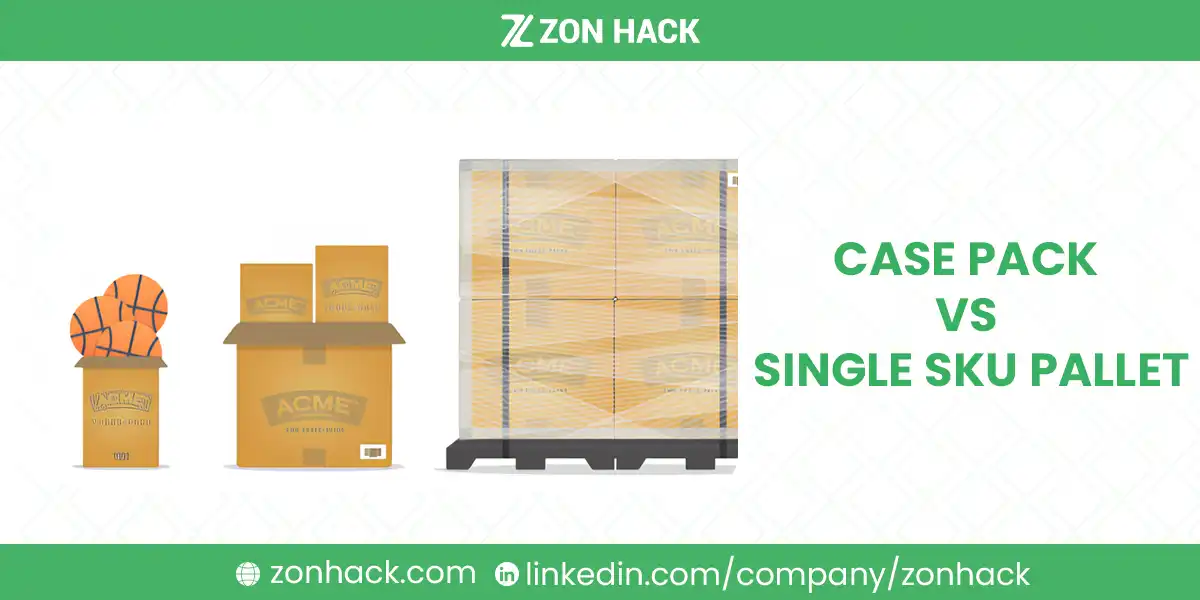
The case pack vs single SKU pallet decision comes down to volume and handling: a case pack is a carton holding a set count of identical units (12, 24, 48), easy to move by hand and flexible to store, while a single SKU pallet stacks hundreds of identical units on one pallet for bulk efficiency at the cost of needing forklifts, dock access, and warehouse space.
Neither is “better.” I want to be clear about that up front. They solve different volume problems, and most growing ecommerce operations end up using both, often for the same item at different stages. What follows is my honest comparison, including the part most articles skip: what this choice means for your Amazon FBA inbound shipments, where the case pack has a specific technical meaning with rules attached.
We plan inbound logistics for client catalogs. We have routed both formats hundreds of times, and I’ve found the mistakes cluster in predictable places. The trade-offs below come from those shipments.
Definitions, quickly
Case pack: a manufacturer’s carton containing a fixed quantity of one product, boxed for handling and protection. Retail supply chains run on these.
Single SKU pallet: one pallet, one product, stacked in bulk and stretch-wrapped. The unit of measure for LTL (less-than-truckload) and full-truckload freight.
The two are not mutually exclusive: a pallet is usually built from cartons. What you are actually choosing is which unit your operation plans, ships, and stores around.
The key differences
| Factor | Case packs | Single SKU pallet |
|---|---|---|
| Typical quantity | 12-48 units per carton | Hundreds of units |
| Handling | By hand | Forklift or pallet jack |
| Storage | Flexible, shelf-friendly | Racking and floor space |
| Packaging cost per unit | Higher (more cartons) | Lower |
| Freight fit | Parcel and small shipments | LTL and truckload |
| Flexibility | High, mix SKUs freely | Low, one product per pallet |
When case packs win
- Inventory control across many SKUs. Counting and picking by carton keeps a multi-SKU warehouse sane. Trust me on this one.
- Fragile or sensitive products. Smaller boxed quantities protect better and localize damage when it happens. Not if. When.
- Parcel-network shipping. Cartons ride UPS and FedEx without freight appointments, which keeps small, frequent replenishments cheap and fast.
The downsides: more packaging material per unit, more boxes to touch, and at genuinely high volume, a shipping cadence that starts to look silly against one pallet a month.
When single SKU pallets win
- Per-unit cost. Minimal packaging overhead and bulk freight rates make the pallet the cheapest way to move volume.
- Warehouse efficiency. One pallet position holds what might otherwise be forty carton slots.
- Bulk purchasing. Suppliers price better at pallet quantities, and in my experience the pallet-quantity discount is often what tips the math.
The downsides: you need equipment and dock access, damage risk concentrates (one badly wrapped pallet is a hundred ruined units, not twelve), and you get zero mix flexibility. Committing to pallets before your demand justifies them is the classic overreach; I have watched sellers pay storage on eight months of inventory to win a discount worth three weeks of it.
The Amazon FBA angle, where this choice has rules
If you sell on Amazon, “case pack” is not just a logistics preference; it is a shipment type with requirements.
Case-packed shipments in Send to Amazon require every carton to contain the same SKU in the same quantity, matching what you declared. Amazon receives them faster because one scanned carton represents them all. Break the uniformity (mixed products, uneven counts) and you must ship as individual units instead, which receives more slowly and invites discrepancies.
Case pack limits matter: keep cartons inside Amazon’s inbound limits (50 lb standard weight ceiling and standard dimensions), and units per case consistent. Your supplier should build cartons to these specs from the start, which is a conversation to have before production, not at the freight forwarder’s warehouse. Our FBA prep center guide covers who fixes it when that conversation did not happen.
Pallets enter the picture at LTL volume. Palletized inbound (single SKU per pallet where possible) cuts your per-unit freight cost and receiving friction at volume. And if you are importing container loads, the pallet question connects to two bigger decisions: ocean freight routing and whether bulk stock should sit upstream in Amazon’s AWD program rather than a third-party warehouse, feeding FBA automatically.
The pattern we set up most often for import clients: supplier builds uniform cartons to Amazon spec, they ride to port on single SKU pallets, and the same cartons later flow into FBA either directly or via AWD. One packaging decision at the factory serves the entire chain. That is the outcome I aim for every time.
How to decide: three questions
1. What is the product? Fragile, perishable, or high-value goods favor cartons for protection and smaller exposure per shipment. Durable, uniform, high-volume merchandise favors pallets.
2. What is the true velocity? Match the shipping unit to real demand, not hoped-for demand. In my experience this is where sellers fool themselves most. A product selling 40 units a week does not need pallet inbound; a product selling 400 does, and shipping it by carton wastes money every single week.
3. What can your infrastructure handle? No dock, no forklift, no racking means cartons by default, or a 3PL that has all three. Be honest here; I have seen the pallet savings evaporate the day handling improvisation started damaging stock.
The cost picture
| Cost factor | Case packs | Single SKU pallet |
|---|---|---|
| Packaging materials | Higher, every carton counts | Lower per unit |
| Handling | Cheap tools, more touches | Equipment needed, fewer touches |
| Freight | Higher per unit, flexible | Lower per unit at volume |
| Inventory carrying | Higher per unit stored | Lower, denser storage |
| Damage exposure | Localized, small | Concentrated, large per incident |
Read the table as a volume dial rather than a verdict: as weekly units climb, every row tilts toward the pallet. The crossover point differs by product, but when your parcel invoices for one SKU exceed what an LTL pallet would cost monthly, you have passed it.
Final verdict
Choose case packs for multi-SKU flexibility, fragile goods, parcel shipping, and any volume your hands can manage. Choose single SKU pallets once one product’s volume justifies bulk freight and you have (or rent) the infrastructure to receive them. Run both where the catalog splits. For Amazon inbound, build supplier cartons to case-pack spec from day one; I’d call retrofitting packaging after production the most avoidable expense in this entire decision.
If you want the packaging spec, freight leg, and FBA routing planned as one system, that is what our global shipping and logistics team does for import-heavy sellers.
FAQ
What is the difference between a case pack and a single SKU pallet?
A case pack is a carton holding a fixed count of one product (commonly 12-48 units), movable by hand. A single SKU pallet stacks hundreds of identical units on one pallet for bulk freight and requires equipment to handle. Pallets are usually built from case packs.
Which is more cost-effective?
Per unit, the pallet wins at volume: less packaging, cheaper freight, denser storage. Case packs win at lower volumes and for mixed catalogs, where pallet infrastructure and minimums would sit idle.
What counts as a case pack for Amazon FBA?
A case-packed FBA shipment requires every carton to contain the same SKU in the same quantity, matching the declared count, within Amazon’s carton weight and size limits. Uniform case packs receive faster at fulfillment centers than individual-unit shipments.
Can I use both case packs and pallets?
Yes, and most import operations should: suppliers build uniform case packs, the cases travel on single SKU pallets for the freight leg, and the same cases feed FBA or a warehouse afterward. One factory packaging spec serves the whole chain.
When should I switch from cartons to pallet shipments?
When one SKU’s recurring parcel costs exceed what an LTL pallet would cost for the same monthly volume, or when receiving friction (lost cartons, slow check-ins) starts costing sales. Run the comparison per SKU rather than for the catalog as a whole.
Do single SKU pallets need special equipment?
Yes: a forklift or pallet jack, dock or liftgate access, and storage that accepts pallets. Without them, use case packs or route pallets through a 3PL or prep center that has the infrastructure.
Last updated: August 26, 2026. Amazon’s inbound carton and pallet requirements change; Seller Central’s current shipment creation rules are the authority for FBA specifics.