
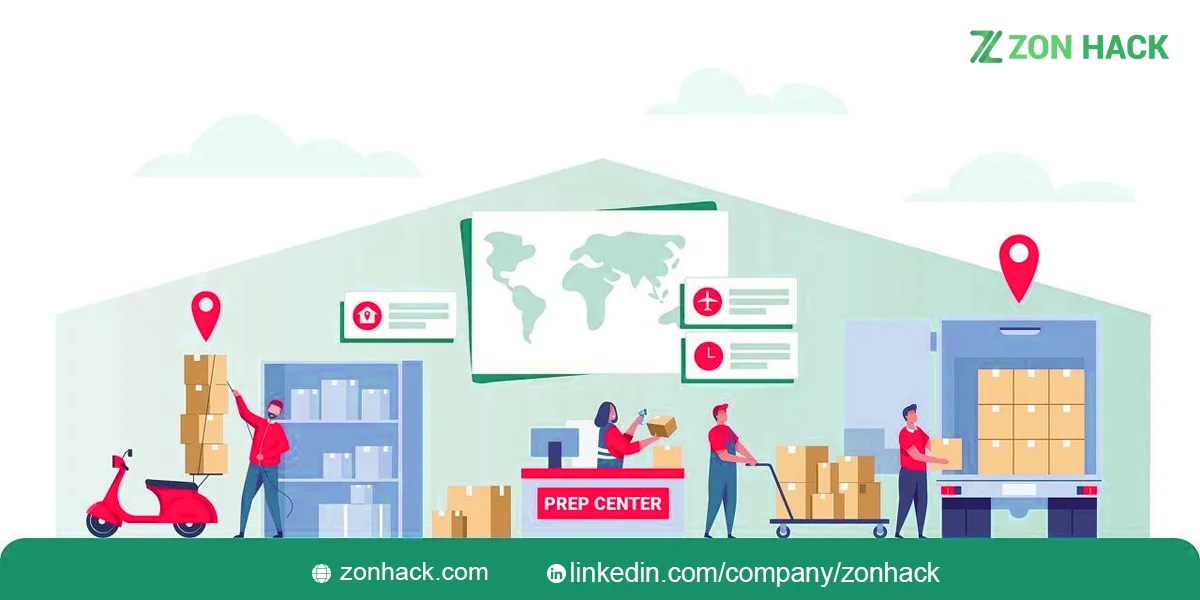
An FBA prep center is a third-party warehouse that receives your inventory, preps it to Amazon’s requirements (labeling, poly-bagging, bundling, inspection), and ships it to Amazon’s fulfillment centers on your behalf. Most charge $1–$2 per unit. Whether you need one depends on your volume, your sourcing model, and whether your time is worth more than the per-unit fee.
That last sentence is the whole decision. Let’s make it concrete.
Do you actually need a prep center?
You have three ways to get inventory prepped, and most guides skip the comparison entirely:
| Option | Cost signal | Best when | Watch out for |
|---|---|---|---|
| DIY prep | Your time + supplies | Low volume, home-based, tight margins | Hours lost weekly; label errors on your record |
| Amazon’s FBA prep service | Discontinued in the US from January 1, 2026 | No longer an option | Amazon now points sellers to DIY or a prep provider |
| Third-party prep center | ~$1–$2/unit | Arbitrage/wholesale volume, tax-free states, custom needs | Quality varies wildly between providers |
The cutoffs, from my experience working seller accounts:
- Under ~200 units a month, DIY usually wins on cost. I think that cutoff is lower than most sellers admit. Your evenings pay for it, though.
- Simple, uniform products with no special handling: this used to be the case for Amazon’s own prep service, but Amazon stopped offering prep and item labeling for US FBA shipments on January 1, 2026. Now it’s DIY or a prep center, and Amazon lists vetted prep providers in its Service Provider Network.
- Arbitrage or wholesale at volume, mixed suppliers, or overseas sourcing: this is prep-center territory, and the rest of this guide is for you.
What services do FBA prep centers offer?
Prep centers handle everything between your supplier and Amazon’s dock door:
- FNSKU labeling. Printing and applying Amazon’s barcodes to every unit, carton, and pallet. This is the service everyone starts with.
- Poly bagging and bubble wrap. FBA-approved bags with suffocation warnings for loose or fragile units. Amazon rejects shipments without them.
- Packaging and palletizing. Boxes, master cartons, and pallets built to Amazon’s packaging requirements.
- Bundling. Combining complementary products into a single sellable unit, labeled to Amazon’s bundle rules.
- Inspection. Opening shipments to catch missing units, damage, and defects before Amazon (or a customer) does. If you source from overseas, a pre-shipment inspection at the factory catches problems even earlier, before you’ve paid international freight on defective stock.
- Warehousing. Holding inventory outside Amazon so you can drip-feed stock and dodge Amazon’s long-term storage fees. Dedicated storage services do this at scale with climate control.
- Inserts and marketing materials. Manuals, thank-you cards, and inserts added to packages on request.
What does an FBA prep center cost?
Most prep centers charge $1–$2 per standard unit, with modifiers that matter more than the base rate:
- Oversized or fragile items run higher.
- Volume discounts typically start around a few hundred units per month.
- Extras (bundling, inserts, long-term storage) are billed separately.
- Some centers charge a monthly minimum or membership fee. Ask, because it changes the math at low volume.
Honestly, the only math that matters is against your own hourly value. If prepping 500 units takes you 20 hours and a center charges $1.25/unit, you’re paying $625 to buy back half a working week. For most growing sellers, that trade is obvious. Factor prep fees into your margins with the rest of your landed costs before committing.
What to look for in an FBA prep center
Five factors separate good centers from expensive mistakes:
- Location. Two plays here: a sales-tax-free state (Montana, Delaware, Oregon, New Hampshire) if you buy retail for arbitrage, or near a port if you import, which saves freight on every container.
- Pricing structure. Per-unit vs monthly plans. Per-unit suits irregular volume; flat monthly wins once you’re shipping steadily.
- Turnaround time. 24–48 hours from receiving to shipped is the standard worth holding out for. Slow prep is stranded capital.
- Tracking and communication. You want photo confirmation, real-time inventory counts, and a human who answers. I’ve seen sellers discover a month too late that “received” didn’t mean “shipped.” One client lost an entire Q4 restock window that way.
- Special handling. Hazmat, meltables, books, apparel. Confirm capability before you sign, not after your shipment gets refused.
Red flags I’d walk away from
Four warning signs come up again and again when sellers tell us prep-center horror stories:
- No insurance disclosure. If they can’t tell you what happens when they damage your inventory, the answer is “nothing good.”
- Vague receiving process. Centers that don’t photograph and count on arrival can’t prove your supplier shorted you, and you can’t prove they did.
- Prices that only exist on a phone call. Honest centers publish per-unit rates. Quote-only pricing usually means the rate depends on how much they think you’ll pay.
- No Amazon-specific experience. General warehouses take FBA work and learn Amazon’s rules on your shipments. Ask how many FBA shipments they process monthly, and I’d want a number in the hundreds.
How to start with a prep center (first shipment)
- I always recommend a small test batch first: 50–100 units, one SKU. You’re testing their receiving accuracy, turnaround, and communication, not saving money yet.
- Give them your FNSKU labels and packaging spec in writing, plus photos of correct finished units.
- Watch the first shipment all the way into Amazon’s system. Check the received count in Seller Central against what your supplier shipped.
- Only then move your volume, and keep your supplier packing lists forever. Discrepancy disputes are won with paperwork.
Choosing an FBA prep center in California
California is the obvious prep location for one reason: the ports. The Port of Los Angeles says it has been the No. 1 container port in the US every year since 2000, and it handled 10,239,318 TEUs in 2025. The neighboring Port of Long Beach handled 9,881,595 TEUs in the same year, by its own figures. If your containers land there, a prep center near the ports can unload, inspect, label and send cartons to Amazon without the stock crossing the country first.
The trade-off is cost. Prep is labor, and California’s minimum wage is $16.90 an hour in 2026, rising to $18.42 in the City of Los Angeles and $18.47 in unincorporated Los Angeles County from July 1, 2026. Expect California quotes to reflect that.
This matters more since January 1, 2026, when Amazon stopped prepping and labeling US FBA inventory itself. Units that need prep must arrive ready.
When I compare California prep centers, I’d ask:
| Question | Why it matters |
|---|---|
| How far are you from the port and from your usual Amazon destinations? | Drayage and transfer time add up quickly |
| Do you handle container unloading and pallet breakdown? | Not every prep center takes floor-loaded containers |
| What’s your turnaround from arrival to shipment to Amazon? | Slow prep turns into stockouts at peak |
| Do you inspect units and photograph defects? | Your evidence if something is wrong at the factory |
| Are you listed in Amazon’s Service Provider Network? | Amazon says it has vetted those providers |
Not every seller needs a California prep center, though. If you ship domestically from suppliers elsewhere, the closest good prep center to them usually beats one near a port. Our guide to Amazon warehouses in California shows where inventory tends to end up.
Where ZonHack fits in this picture
We’re not a prep center, and honestly, a good local prep center is hard to beat for pure labeling volume. What we run for clients is the layer around it: global shipping and logistics from factory to FBA (freight, customs, carrier coordination), product inspection at origin, and overflow storage. As a verified Amazon SPN partner, we also coordinate prep as part of full account management, useful when you’d rather hand off the whole supply chain than manage three vendors.
FAQ
How much does FBA prep cost per unit?
Third-party prep centers average $1 to $2 per standard unit, plus extras for bundling, oversized items, or storage. Amazon’s own prep service no longer exists in the US. DIY costs supplies plus your hours, which is the number sellers most often forget to count.
What’s the difference between a prep center and a 3PL?
A prep center is built around Amazon’s inbound requirements: FNSKU labels, poly-bag specs, carton rules. In my experience, that specialization is worth real money. A 3PL is a general fulfillment warehouse that stores and ships orders across channels. Many 3PLs offer FBA prep as a side service, but centers that live and breathe Amazon’s requirements make fewer compliance mistakes.
Can Amazon prep my products for me?
Not any more in the US. Amazon ended its FBA prep and item labeling services for US shipments created from January 1, 2026. You prep yourself or use a prep provider, and Amazon lists vetted ones in its Service Provider Network. Shipments that arrive without proper prep or labels aren’t eligible for reimbursement if damaged or untraceable.
Should I use an FBA prep center in California?
If your goods arrive through the ports of Los Angeles or Long Beach, often yes, because the prep happens before inventory moves inland. Expect higher labor costs: California’s 2026 minimum wage is $16.90 an hour, and higher in the City of Los Angeles.
Do I need a prep center for private label products?
Usually not. Your manufacturer should prep and label to Amazon spec as part of production, and a factory-side inspection confirms they did. Private label sellers mostly use prep centers as a backstop: re-labeling after listing changes, fixing supplier mistakes, or splitting shipments between marketplaces.
Last updated: October 17, 2026. Prep fees change; confirm current rates with any provider you contact. Sources: Amazon, FBA Prep Service (discontinued in the US from January 1, 2026); Port of Los Angeles, facts and figures; Port of Los Angeles, container statistics; Port of Long Beach, port statistics; California DIR, minimum wage; City of Los Angeles, minimum wage; LA County, minimum wage.