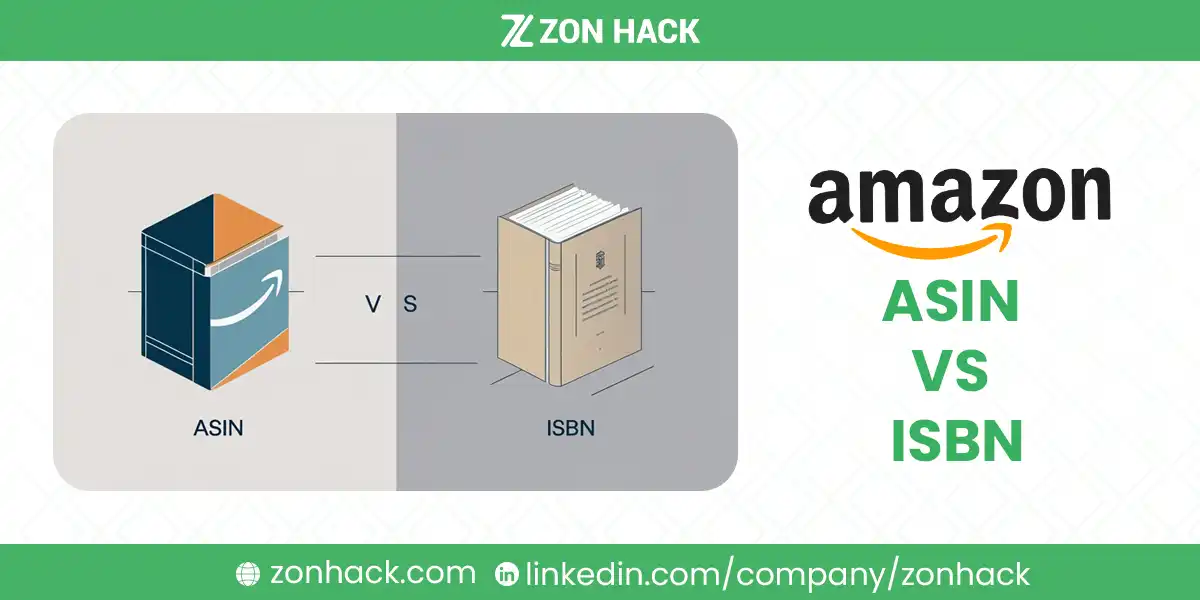
The ASIN vs ISBN distinction confuses more authors than any other pair of acronyms in publishing, so here it is plainly. An ASIN is Amazon’s internal product code, ten alphanumeric characters, assigned by Amazon to every item in its catalog. An ISBN is a global book identifier, ten or thirteen digits, issued by national ISBN agencies and recognized by every bookstore, library, and distributor in the world.
The practical difference: an ASIN works only inside Amazon, while an ISBN works everywhere including Amazon. We handle catalog setup for client accounts constantly, and I’ve found this single sentence resolves most of the confusion. A printed book typically carries both. A Kindle ebook usually carries only an ASIN.
For authors one choice carries genuine consequences: accepting KDP’s complimentary number versus purchasing your own. I’ll reach that shortly, because the free route hides a restriction writers typically discover far too late.
What an ASIN is
The Amazon Standard Identification Number labels a catalog page. Amazon mints it automatically the moment an item first appears, and every merchant offering that same product shares it. You never purchase or apply for one.
Books break the usual pattern. Most merchandise receives a random-looking string like B08XYZ1234. Printed volumes, though, frequently inherit their ISBN-10 as that code, which is precisely why writers conflate the two. Occasionally they align. Frequently they diverge. Depending on either behavior is a mistake.
Our full explainer on how these codes work across the catalog sits in what is an Amazon ASIN number, and the wider identifier landscape is mapped in our barcodes guide.
What an ISBN is
The International Standard Book Number pinpoints one particular edition of one particular title. Hardcover, paperback, and audio versions of a single work each demand a separate number, because the supply chain treats them as distinct goods.
These numbers issue from official agencies, one per territory (Bowker in America, Nielsen in the UK), and they cost money. Thirteen digits since 2007; older volumes carry the shorter ten-digit form.
What that number purchases is distribution. Bookstores order by it. Libraries catalog by it. Wholesalers, review databases, and sales trackers all pivot on it. Lacking one, your title effectively does not exist beyond whichever platform published it.
ASIN vs ISBN, side by side
| Feature | ASIN | ISBN |
|---|---|---|
| Scope | Amazon only | Worldwide, all book channels |
| Identifies | Any product page on Amazon | One specific edition of a book |
| Assigned by | Amazon, automatically | National ISBN agencies |
| Format | 10 alphanumeric characters | 10 or 13 digits |
| Cost | Free | Paid, cheaper in blocks |
| Required for | Any Amazon listing | Selling through bookstores, libraries, other retailers |
| Applies to | Books and every other category | Books only |
Where the two overlap
Amazon borrows a printed volume’s ISBN-10 for its catalog code where possible, which breeds the illusion that both are one thing. They are separate. A catalog code survives without any book number (consider every Kindle title, every non-book good), and a book number exists wholly independently of Amazon.
I’d hold onto this framing, because it settles most confusion: the book number belongs to your work, while the catalog code belongs to Amazon’s page describing your work. Ownership rests in different hands.
The KDP ISBN decision, which actually matters
Kindle Direct Publishing hands you a complimentary number for paperback and hardcover editions. Sounds like an obvious yes. Here lies the snag: a KDP-supplied number names Amazon as publisher of record and cannot carry that edition anywhere else.
So the choice is:
Accept the complimentary one if Amazon is your sole intended channel and Amazon appearing as publisher does not trouble you. For plenty of independent writers testing a debut, I’d call that perfectly sensible.
Purchase your own if you want your imprint credited, you intend approaching bookstores or libraries, or you might distribute via IngramSpark or a similar aggregator later. Buying a block cuts the unit price substantially, and you will need several regardless once formats multiply.
Why do I flag this so firmly? Switching afterwards means a fresh number and effectively a fresh edition, forfeiting the reviews and sales history welded to the original. Cheap to decide correctly at the outset. Expensive to unwind.
Digital Kindle editions require nothing of the sort. Amazon assigns a catalog code and that suffices, unless you also publish through Apple Books, Google Play Books, or Kobo, each of which wants a proper number.
The other identifiers you will meet
Publishing is unusual in operating its own numbering system. Every other category on Amazon leans on the GTIN family:
- UPC: 12 digits, North American retail standard
- EAN: 13 digits, European and international
- GTIN: the umbrella term covering UPC, EAN, ISBN, and JAN
- FNSKU: Amazon’s per-seller FBA label, which is a different job entirely, covered in our Amazon barcodes guide
Notice that a book number is itself a GTIN, which explains why Amazon accepts it where a UPC would otherwise sit. Other merchandise demands a genuine GS1-issued UPC or EAN, and recycled resold barcodes trigger rejections. Worth repeating, since it snares newcomers constantly.
A worked example, since abstraction obscures this
Imagine a novelist publishing one title in three formats.
The paperback receives a book number, either purchased or supplied by KDP, plus an Amazon catalog code that may mirror its ISBN-10. The hardcover needs its own separate book number, being a distinct edition, and gains its own catalog code. The Kindle edition needs no book number whatsoever and receives only a catalog code beginning with B.
Three formats. Two purchased numbers if the writer buys their own, or two free ones through KDP. Three Amazon codes, none of which the author controls.
Now suppose that novelist later approaches an independent bookstore chain. Purchased numbers travel fine. KDP-supplied ones do not, because Amazon is named publisher on those records. The writer must issue fresh numbers, republish both print formats as new editions, and abandon whatever reviews accumulated against the originals. I have watched exactly this unfold, and the wasted year is what makes the opening decision worth ten minutes of genuine thought.
What sellers should take from this
Reselling volumes you did not publish? Neither concerns you much. The catalog page exists, the number sits printed on the back cover, and you simply list against what is already there.
Publishing your own book? ISBN strategy is your decision to make deliberately, per the section above. The ASIN takes care of itself.
Selling non-book products? Ignore ISBNs entirely. You need a GS1 UPC or EAN, or a GTIN exemption, plus FNSKU labels for FBA inventory.
Managing a mixed catalog? Keep a single reference sheet mapping your SKU to its ASIN, its GTIN (ISBN, UPC, or EAN), and its FNSKU. In our experience that one spreadsheet prevents most catalog confusion, and I’d call it indispensable the moment something mismatches. We tested going without it once. Never again.
If listing setup and identifier compliance is where you keep losing time, that is standing work for our expert listing service, and getting the identifiers right at creation is far cheaper than untangling them afterward.
FAQ
What is the difference between ASIN and ISBN?
An ASIN is Amazon’s internal 10-character product code, assigned automatically and valid only on Amazon. An ISBN is a 10 or 13-digit global book identifier issued by official agencies and recognized by bookstores, libraries, and distributors worldwide.
Is an ASIN the same as an ISBN for books?
Sometimes Amazon uses a print book’s ISBN-10 as its ASIN, but they are different identifiers with different owners and scope. Never assume they match, and never treat an ASIN as a substitute for an ISBN outside Amazon.
Do I need an ISBN to sell a book on Amazon?
Not for Kindle ebooks, which get an ASIN instead. Paperback and hardcover editions need an ISBN, and KDP will supply one free, though that version cannot be used to distribute the same edition elsewhere.
Should I use the free KDP ISBN or buy my own?
Take the free one if Amazon is your only channel and you accept Amazon as publisher of record. Buy your own if you want your imprint credited or plan wider distribution, since changing later requires a new ISBN and a new edition.
Do Kindle ebooks have ISBNs?
They do not require one; Amazon assigns an ASIN. You will need an ISBN only if you distribute the same ebook through other platforms such as Apple Books, Google Play Books, or Kobo.
What identifier do I need for non-book products on Amazon?
A GS1-issued UPC or EAN (both GTINs), or an approved GTIN exemption. Add FNSKU labels for FBA inventory. Barcodes bought from resellers fail Amazon’s GS1 validation and can get listings removed.
Last updated: August 27, 2026. KDP’s ISBN terms and Amazon’s product-identifier requirements change; verify current rules in KDP help and Seller Central.