
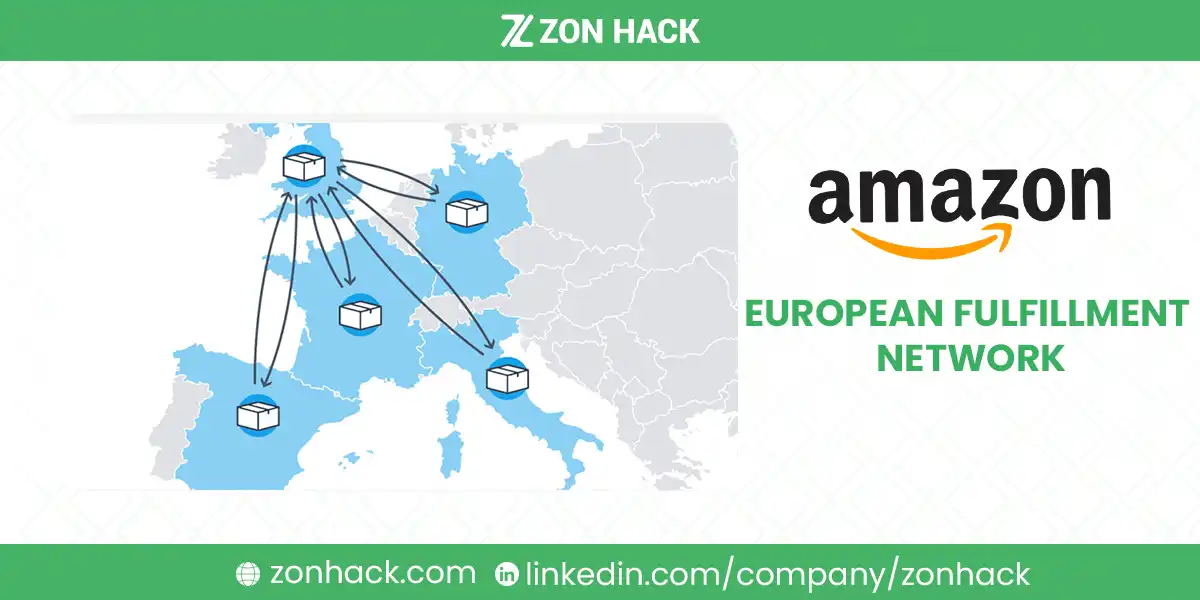
The Amazon European Fulfillment Network (EFN) lets you hold stock in one European country and fulfil orders from every other European marketplace out of that single pool. One inventory location. Five or more storefronts. The trade-off is a cross-border fulfillment fee on each international order and slower delivery than local stock.
We have run European expansion for client accounts, and the decision almost always comes down to one number: how many units per month you actually sell in the other countries.
How the Amazon European Fulfillment Network works
You send stock to one Amazon warehouse. Germany, usually. A customer in France, Italy, or Spain orders, and Amazon ships from Germany across the border. Your listings show up on every connected European marketplace. No splitting stock, no second forecast.
Three practical consequences:
- One shipment, many markets. You manage a single inventory position rather than five.
- A cross-border fee applies on every order fulfilled from another country, and it is meaningfully higher than domestic FBA fulfillment.
- Delivery takes longer to distant markets, which affects the Prime badge you can offer and, in my experience, conversion rate too.
What EFN actually costs
Amazon charges the standard FBA fulfillment fee for domestic orders and an EFN cross-border fee for orders shipped internationally. Rates vary by size band and destination, and Amazon revises them, so pull the current fee schedule in Seller Central rather than trusting any figure you read online, including here.
The pattern matters more than the exact figure. It always does. Cross-border fulfillment costs several euros more per unit than local fulfillment. On a €15 product that difference decides whether the market is worth entering; on a €60 product it barely registers.
I’ve found sellers underestimate this on low-price items and then wonder why European expansion made revenue grow and profit shrink.
When EFN is the right choice
- You are testing new markets. Nothing beats it for learning whether France buys your product. Cheap answer, no committed stock.
- Volume in secondary markets is low. A few orders a week never justifies splitting inventory. I would not bother.
- Your margins are healthy. Higher-priced goods absorb the cross-border fee comfortably.
- You want operational simplicity. One stock pool, one reorder decision, one set of forecasts.
When EFN becomes the wrong choice
Once a secondary market gets busy, the fees start costing more than the complexity you avoided.
Watch for these signals:
- Steady daily orders in a country where you hold no stock.
- Cross-border fees becoming a visible line in your profit and loss.
- Delivery promises losing you the sale to a locally stocked competitor.
- Low-margin products where a few euros per unit erases the profit.
At that point, look elsewhere. Pan-European FBA or local fulfillment.
EFN versus Pan-EU versus a local 3PL
| Option | Fulfillment cost | Complexity | Best when |
|---|---|---|---|
| EFN | Highest per cross-border unit | Lowest | Testing markets, low volume |
| Pan-European FBA | Lowest per unit | Highest (VAT in each country) | Proven volume in several markets |
| Local 3PL | Middle | Middle | One strong secondary market |
| Multi-Country Inventory | Low | Middle-high | You want control of where stock sits |
Pan-European FBA removes cross-border fees by letting Amazon distribute your stock across countries. The catch is tax: holding inventory in a country generally creates a VAT registration obligation there, so you take on filings in multiple jurisdictions. The fulfillment saving is real, and so is the accounting bill.
A local 3PL suits one situation: a single secondary market that has grown up. Ship a container to that country, fulfil locally, keep EFN for the rest.
In our experience the usual path is EFN first, then Pan-EU for the two or three markets that prove themselves, with EFN still covering the long tail. Very few sellers should jump straight to Pan-EU.
VAT and compliance, briefly
This is where European expansion catches people out, so treat it as a real workstream rather than paperwork.
- EFN with stock in one country generally means one VAT registration in that country, plus distance-selling rules for cross-border sales.
- Pan-EU means VAT registration wherever Amazon places your stock. That is the price of the lower fees.
- The IOSS and OSS schemes changed how cross-border VAT is reported for EU sales; your accountant should tell you which applies.
- Post-Brexit UK is separate. UK stock does not serve EU customers under these programs.
Hire an accountant who has done marketplace VAT before. I mean it. I have watched sellers save on fulfillment and lose twice as much to late filings and penalties.
A practical sequence for entering Europe
- Pick one market to test properly, usually Germany for volume or the UK for language.
- Translate listings properly. Machine translation reads badly and costs conversion, which our listing optimization team handles when it matters.
- Run EFN for a full quarter. You need seasonality, not a two weeks.
- Read the numbers per country, not in aggregate. Aggregate hides the market that is losing money.
- Move to local stock only where volume justifies it. One market at a time, with the VAT work done first.
- Get freight right. Cross-border shipping and customs sink more European launches than pricing does, which is why we run global shipping and logistics as a service.
That sequence is slower than the launch-everywhere advice elsewhere. Deliberately so. It is also the one that keeps margins intact.
FAQ
What is the difference between EFN and Pan-European FBA?
EFN keeps your stock in one country and charges a cross-border fee to ship abroad. Pan-European FBA distributes your stock across several countries, removing the cross-border fee but creating VAT obligations in each country holding inventory.
Does EFN affect Prime eligibility?
Your products can be Prime eligible across connected marketplaces, but delivery from another country takes longer than local fulfillment. Against a locally stocked competitor, that difference costs you sales on identical products.
Do I need a VAT number in every European country for EFN?
Generally no, because stock sits in one country. You need registration where your inventory is held, plus compliance with the current cross-border VAT scheme for your sales. Confirm specifics with an accountant, since thresholds and schemes change.
Is EFN worth it for low-priced products?
Often not. The cross-border fee is a fixed cost per unit, so it consumes a much larger share of a €12 item than a €60 one. Model it per SKU before enrolling, not after.
Can I use EFN and a local 3PL at the same time?
Yes, and it is a sensible combination. Stock locally in your strongest secondary market and let EFN serve the smaller ones from your main pool.
Last updated: August 24, 2026. Amazon revises EFN fees and program terms periodically; check current rates in Seller Central before modelling.