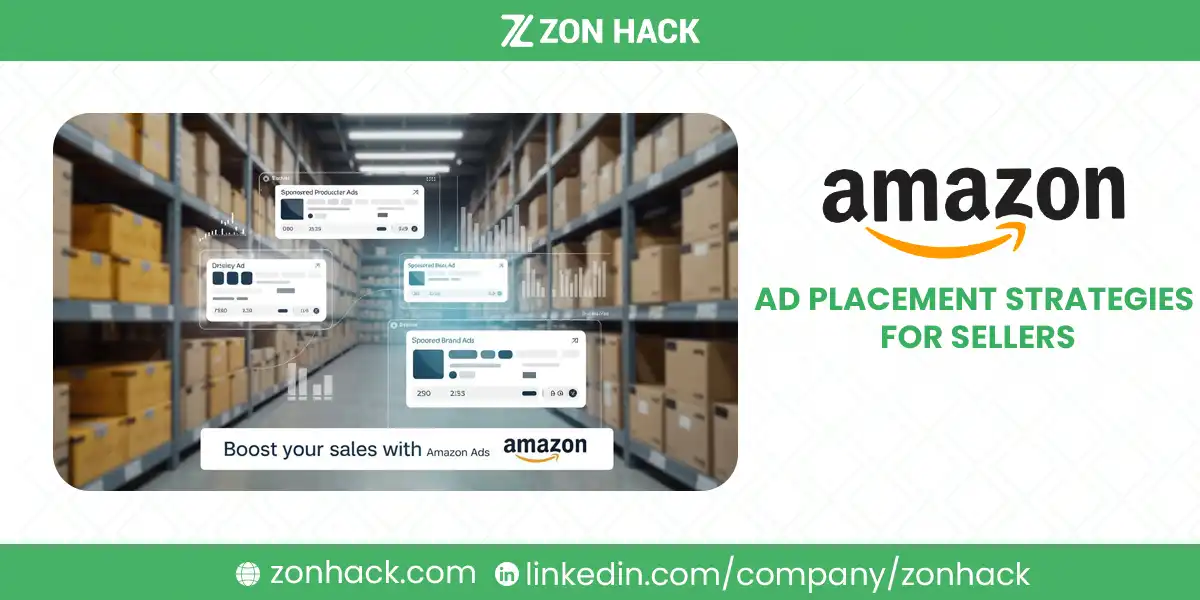
Amazon ad placement is where your ad appears rather than who sees it: top of search, the rest of the search results, or on a product detail page. Amazon lets you bid differently for each, and placement bid adjustments are the most underused control in Sponsored Products.
The reason to care is that the same keyword performs completely differently depending on position. Top of search costs the most and converts the best. Product pages are cheap and inconsistent. Rest of search is cheap and quiet. Bidding the same amount for all three is leaving money on the table in both directions.
Before the tactics, one correction. A lot of published guidance on this topic quotes precise performance benchmarks per placement, attributed to internal Amazon data or to tool vendors. Those tables are not real. Amazon does not publish placement-level CTR and conversion benchmarks, and the figures that circulate cannot be traced to a source. Your own placement report is the only benchmark that means anything, and it takes two minutes to pull.
We run Amazon advertising for client accounts as an Amazon Ads partner and an Amazon SPN Verified Partner. Below is what the controls do and how to use them.
The placements, and what each is for
Top of Search, first page. The slots above the organic results. Highest cost per click. Highest click-through. Generally the best conversion too, because a shopper reading the top of the page is at their most decisive and has not yet started comparing eleven alternatives. This is where you defend your own brand terms and where you compete for high-intent keywords.
Rest of Search. Ads further down the results and on subsequent pages. Cheaper clicks. Lower volume. Useful for long-tail terms where you want presence without paying premium rates, and occasionally the only economical way to appear at all on a head term where the top slots have been bid into territory your margin cannot follow.
Product pages. Ads on detail pages, including competitors’. Cheap and variable. Excellent for conquesting and for complementary products. Poor when your product is simply a worse version of the one being viewed, and I’ve found sellers rarely admit that is the situation until the report says so.
Amazon Business placements, where applicable, reach business buyers specifically and behave differently enough to be worth separating.
For Sponsored Brands, placements include the banner at the top of search and positions further down the page, plus video placements within results. Sponsored Display reaches detail pages, search results, and third party sites and apps through Amazon’s ad network. Our guide comparing Sponsored Products, Brands, and Display covers how the formats divide the work.
A correction worth making
Older guidance on this topic, including the previous version of this article, referred to Amazon Quality Score and described a chain reaction where low click-through raises costs.
Amazon does not have a Quality Score. That is a Google Ads concept and it does not exist on Amazon in that form. Amazon does weigh relevance and historical performance when deciding which ads to show and where, so the underlying idea that performance affects your costs is not entirely wrong. But there is no published score, no number to optimize, and no diagnostic panel showing it. Anyone offering to improve your Amazon Quality Score is describing something that does not exist.
How bid adjustments actually work
This is the mechanical part. Getting it wrong is expensive.
You set a base bid, then optionally add a percentage increase for specific placements. If your base bid is $1.00 and you set a 50% adjustment for top of search, Amazon may bid up to $1.50 when competing for that position.
The adjustment range goes considerably higher than most sellers realize. That is precisely why the next point matters.
Bid adjustments compound with dynamic bidding. Three bidding strategies exist:
- Fixed bids. Amazon uses your bid as set.
- Dynamic, down only. Amazon lowers your bid when conversion looks unlikely.
- Dynamic, up and down. Amazon raises your bid when conversion looks likely and lowers it when it does not.
Combine an aggressive placement adjustment with dynamic up and down bidding and your effective bid can rise well above what you think you authorized. I’ve found this is the single most common way sellers accidentally spend far more per click than intended, and the campaign settings look perfectly reasonable while it happens.
If you are new to this, start with dynamic down only and modest placement adjustments. You can add aggression once you know what the placements actually do for your products.
Reading your own placement data
Skip the benchmark tables. Pull your own numbers instead.
In the Amazon Ads console, open a Sponsored Products campaign and find the placement report. It shows impressions, clicks, spend, sales, and ACoS split by top of search, rest of search, and product pages.
What to look for:
- Which placement produces your sales, not just your clicks. These are frequently different placements.
- ACoS by placement. Top of search often carries a higher cost per click and a better ACoS simultaneously, because conversion compensates.
- Product page performance. If this is spending without converting, your ad is appearing next to products it loses against, and negative targeting is the answer rather than a lower bid.
- Volume. A placement with excellent ACoS on eleven clicks is telling you nothing yet.
Give it enough data before acting. We tested how early these reports become meaningful and 14 days of real volume was the practical minimum. Before that, a placement adjustment is a guess wearing a spreadsheet.
A practical Amazon ad placement strategy
Start neutral. Run new campaigns with no placement adjustments for 2 weeks and let the data arrive. Adjusting on day one means adjusting on assumption, and in my experience the assumption is wrong about half the time.
Then bias toward what works. If top of search converts well, add a modest adjustment. Then watch what happens to total spend rather than to that placement’s ACoS in isolation, because a higher bid that wins more auctions changes the shape of the whole campaign and not merely the column you were looking at.
Increase gradually. Move in steps. Review weekly. A large adjustment applied all at once makes it impossible to tell what caused what.
Separate your defensive campaigns. Brand terms usually deserve top of search aggression, because losing your own brand search to a competitor is worse than paying for it. Keep those in their own campaign so the settings do not have to compromise. I’d treat this as non-negotiable once a brand is established enough to be worth stealing from.
Use negatives on product page placements. If your ads appear on detail pages where you consistently lose, exclude those ASINs. Our guide to keyword versus product targeting covers the targeting side properly.
Judge the whole account, not the placement. Our guide to TACoS, ACoS, and ROAS explains why improving a placement’s ACoS while total sales fall is not a win.
Placement and mobile, briefly
One factor that rarely appears in placement discussions and quietly shapes all of it.
Most Amazon shopping happens on a phone, and a phone screen shows far fewer results before a scroll than a desktop does. That compresses everything. Top of search occupies a larger share of what a shopper actually sees. Rest of search sits further below the fold than the name suggests. Product page placements appear after a long scroll through images and bullets, which is why their performance is so inconsistent.
The practical consequence is that top of search is worth relatively more than desktop-era intuition suggests, and that a placement adjustment which looks aggressive on a laptop may be merely competitive in the environment where the sale actually happens. I’d view your own listings on a phone before deciding what a placement is worth.
Where DSP does and does not fit
Older versions of this guide said that DSP is a must for anyone serious about retargeting. That is not right, and it is worth correcting because it sends sellers toward an expensive answer.
Sponsored Display does retargeting, reaches shoppers on and off Amazon, and costs a few dollars a day to start. For the overwhelming majority of sellers this is the correct tool.
Amazon DSP is a separate programmatic platform with meaningfully higher entry requirements, buying audiences rather than placements. It earns its place when you have a brand budget and an awareness objective search advertising cannot serve. Our comparison of Amazon DSP and Sponsored Display works through when that applies, and for most sellers the honest answer is not yet.
Before placement optimization matters at all
Placement tuning is a refinement. It is worth doing after the fundamentals, and it is worth almost nothing before them.
Conversion comes first. Every placement sends traffic to the same page. If that page converts poorly, no placement is profitable and the best you can achieve is losing money more slowly. Fix the product detail page first.
Keyword selection comes second. Bidding well on the wrong terms is a well-executed mistake. Our guide to search term optimization covers finding the right ones, and I would rather see a seller spend an afternoon on their search terms than a month on their bids.
Campaign structure comes third. Placements are set per campaign, so a campaign mixing brand terms, competitor terms, and generic terms cannot be optimized by placement at all. Separate them and the controls start working.
Then placement. At which point it becomes a genuine advantage rather than a distraction.
If you want the whole program run rather than assembled, that is our advertising management service, and an account audit is the cheaper first step.
FAQ
What is Amazon ad placement?
Where your ad appears rather than who sees it. For Sponsored Products the placements are top of search on the first page, the rest of the search results, and product detail pages, and you can set different bid adjustments for each.
How do Amazon placement bid adjustments work?
You set a base bid and add a percentage increase for a specific placement. A 50% adjustment on a $1.00 base bid means Amazon may bid up to $1.50 for that position. Adjustments compound with dynamic bidding, so effective bids can rise well above what you expect.
Does Amazon have a Quality Score?
No. Quality Score is a Google Ads concept and does not exist on Amazon in that form. Amazon weighs relevance and historical performance when deciding placements, but there is no published score to optimize and no panel showing one.
Which Amazon ad placement performs best?
Top of search usually delivers the highest click-through and conversion at the highest cost per click, but it varies by product and category. Published benchmark tables claiming precise figures per placement are not traceable to a real source. Use your own placement report instead.
Should I use dynamic bidding with placement adjustments?
Carefully. Dynamic up and down bidding combined with an aggressive placement adjustment can push your effective bid far above your base. Start with dynamic down only and modest adjustments, then increase once you understand how your placements perform.
Do I need Amazon DSP for retargeting?
No. Sponsored Display handles retargeting on and off Amazon and starts at a few dollars a day. DSP is a separate programmatic platform with much higher entry requirements, appropriate for brand budgets and awareness objectives rather than routine retargeting.
Last updated: August 29, 2026. Amazon Ads placement options, bid adjustment limits, bidding strategies, and reporting change regularly. The Amazon Ads console carries the current controls and your own placement report is the only reliable benchmark.