
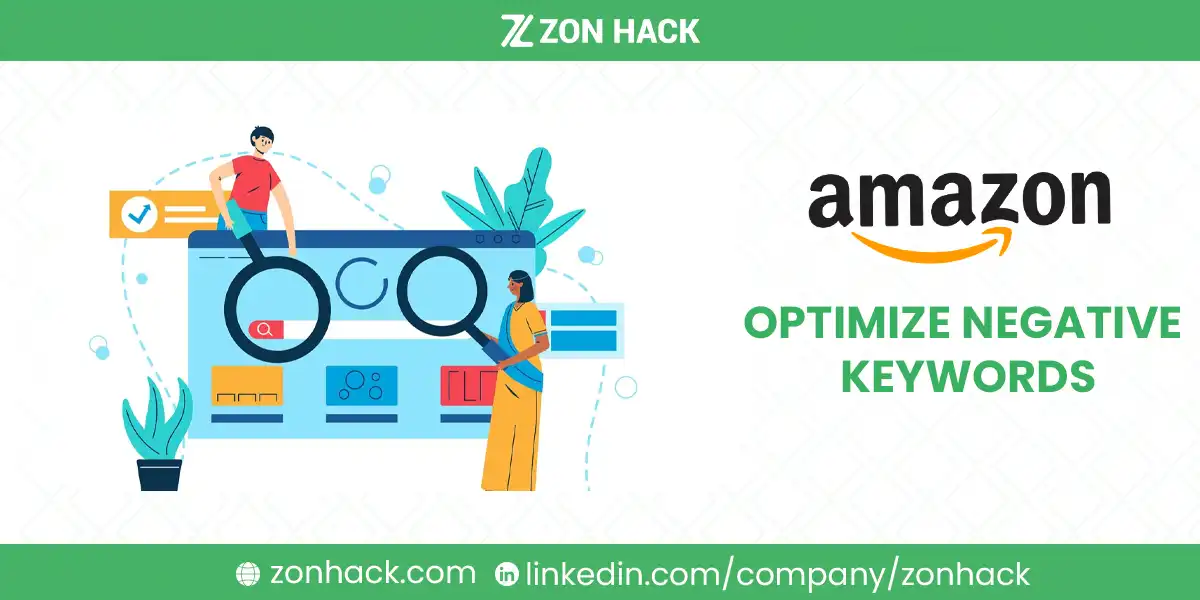
Negative keywords on Amazon stop your ads showing for a search term, and they do two jobs rather
than one. The obvious job is blocking irrelevant traffic. The job that matters more is routing: sending
each search term to the campaign you want handling it, so your own campaigns stop bidding against each
other.
Most accounts use them only for the first job. In our experience that is why they end up paying twice to learn the same thing.
The single highest-value use of negatives is the harvesting step: once a search term proves itself in
a discovery campaign and you move it into an exact-match campaign, you negate it in the discovery
campaign. Skip that and both campaigns keep competing for the term indefinitely.
The two negative match types
Only two, and I’d argue the difference between them decides whether you block too much.
Negative exact. Blocks only that precise phrase. “running shoes for men” blocks that exact string and
nothing else. This is the safe default and the right choice for harvesting.
Negative phrase. Blocks any search term containing that sequence of words in order, which sounds narrow until you apply it: adding “for men” as a negative phrase would block “running shoes for men” and “boots for men” and “waterproof jacket for men” and every other query in which those two words happen to sit next to each other, including several you were happily converting on yesterday. Powerful. Easy to over-apply.
There is no negative broad for keywords in Sponsored Products, which surprises people who come from
Google Ads. For product targeting you negate ASINs and brands rather than keywords, which is a separate
mechanism.
I’d use negative exact for harvesting and negative phrase only for genuinely unwanted intent, such as
“free”, “used”, or a competitor’s brand you do not want to appear against. In our experience the accounts
that over-negate do it with phrase match applied hastily.
Campaign level or ad group level
A real distinction and frequently ignored. When I have audited accounts, negatives were almost always applied at whichever level the interface offered first.
Campaign-level negatives apply to every ad group in the campaign, which makes them the right instrument for the exclusions you would never want anywhere in that campaign regardless of which ad group happened to trigger: wrong intent, wrong product type, terms that describe something you do not sell. Blunt by design.
Ad group-level negatives apply only inside that ad group. This is where routing happens. If two
ad groups in a campaign target overlapping keywords, ad group negatives keep them apart.
The practical rule: blanket exclusions at campaign level, routing at ad group level. Getting that
backwards is how sellers accidentally block a term across a whole campaign when they meant to steer it.
When to add a negative, and when not to
The judgment that separates useful negatives from damaging ones.
Add one when a search term has enough clicks and no sales. Enough means roughly 10 to 15 clicks with
zero conversions, or a spend figure you would be unhappy to repeat. Under 10 clicks you are reading
noise, and negating on that basis is the most common self-inflicted wound in Amazon advertising.
Add one when the term is clearly wrong intent, regardless of clicks. If you sell dog beds and the
term is “dog bed frame for humans”, you do not need data.
Add one after harvesting, always. This is the routing job.
Do not add one because ACoS looks high on a term that converts. A converting term with poor
efficiency is a bidding problem, not a relevance problem. Lower the bid instead. Our guide to
Amazon bid types and strategies covers the
break-even arithmetic that decides which it is.
Do not negate a term because it is expensive. Expensive and unprofitable are different, and the
distinction is your margin rather than the cost per click.
A routine that keeps it under control
Weekly, and it takes about 20 minutes once set up.
- Download the search term report for the last 14 days rather than 7, so you have enough clicks to
read. - Sort by spend, descending. Work top down, because that is where the money is.
- Flag terms with 10 or more clicks and no sales. Negative exact, in the campaign where they
appeared. - Flag converting terms not yet in an exact campaign. Harvest them, then negate them in the source
campaign. - Scan for wrong-intent terms regardless of click count.
- Keep a master list of blanket negatives you apply to every new campaign.
That last point saves the most time over a year. A house negative list means every new campaign starts
without the mistakes you have already paid for. In our experience almost nobody maintains one, and
rebuilding the same exclusions campaign by campaign is pure waste.
A worked example of routing
The routing job is the one people find abstract, so here it is concretely.
You run an automatic campaign for a stainless steel water bottle. Over three weeks it spends across
dozens of search terms and two convert well: “insulated water bottle 1 liter” and “steel water bottle for
gym”.
You create an exact-match campaign for each, with bids set from your break-even rather than from whatever
the automatic campaign happened to pay. Good so far.
Now the step that decides whether this works. If you stop there, the automatic campaign keeps bidding
on both terms. Two of your campaigns enter the same auction. Amazon picks one, you pay for it, and your
reporting splits the history across both so neither shows a clean picture. Worse, the automatic campaign
is buying a term you already know converts, at a bid you did not choose.
So you add both terms as negative exact in the automatic campaign. Now the automatic campaign is free
to keep hunting for terms you have not found, and the exact campaigns own the ones you have. Each does one
job.
Repeat weekly and the account gets cleaner rather than messier over time. In my experience that is the
single behavior that separates accounts that improve from accounts that just get bigger.
What a healthy negative list looks like
A rough sense of scale, because sellers ask whether they have too many or too few.
A mature campaign harvested for 6 months will have dozens of negative exacts, most of them harvested terms rather than blocked junk. Normal. Healthy. In our experience it looks alarming to somebody seeing the list for the first time.
A handful of negative phrases, chosen deliberately, covering intent you never want: “free”, “used”,
“cheap” if you are premium, competitor brands you have decided not to appear against.
A house list of 10 to 20 blanket exclusions applied to every new campaign from day one.
If your negative list is empty after months of spend, terms are being paid for repeatedly. If it runs to
hundreds of phrase negatives, you have probably blocked traffic you wanted and I’d audit it before adding
more.
The mistakes that cost most
No negatives at all. Your campaigns compete with each other and you pay for the privilege. Our guide
to Amazon PPC campaign structure covers why
structure and negatives are the same job seen from two angles.
Negating on small samples. 4 clicks and no sale tells you nothing. I’ve watched accounts negate their
way into irrelevance one under-sampled term at a time.
Negative phrase applied carelessly. One badly chosen phrase can block dozens of terms you wanted,
and because the block is silent, nothing tells you. This is the failure mode I’d watch hardest,
because it looks like nothing happening.
Negating your own brand from a defense campaign, which happens when a blanket list is applied without
reading it.
Never reviewing existing negatives. A term you blocked 18 months ago may be entirely relevant today, because your catalog expanded, or the product changed, or the query itself drifted in meaning as the category moved around it, and none of those things will prompt anybody to revisit a list that is doing its job silently in the background. I’d audit once or twice a year.
Treating negatives as a cost-cutting tool. They cut waste, and waste is not the same as spend. An
account with no waste and no growth has a different problem.
What negatives cannot fix
Worth saying so the tool is not over-asked.
A listing that does not convert. If relevant traffic arrives and does not buy, blocking irrelevant
traffic changes nothing about that. Our guide to
Amazon Brand Analytics covers
diagnosing which funnel stage actually loses the sale.
A structural problem. Negatives patch overlap between badly separated campaigns. They do not fix the
separation, and eventually the patch becomes unmanageable.
A price or stock problem. An out-of-stock product with live campaigns is spending money to advertise unavailability, and no negative list addresses that. I’d check stock before the search term report.
If you would rather have the weekly search term work done than intended, that sits inside our
Amazon PPC service. We are an Amazon Ads
partner and an Amazon SPN Verified Partner.
FAQ
What are negative keywords on Amazon?
Terms that stop your ads showing for a search query. They block irrelevant traffic and, more importantly,
route each search term to the campaign you want handling it so your own campaigns stop bidding against
each other.
What is the difference between negative exact and negative phrase?
Negative exact blocks only that precise search term. Negative phrase blocks any term containing that
sequence of words in order, which is far broader and easy to over-apply. Negative exact is the safe
default and the right choice for harvesting.
How many clicks before I add a negative keyword?
Roughly 10 to 15 clicks with no conversions, or a spend figure you would not want to repeat. Under 10
clicks you are reading noise, and negating on that basis is one of the most common self-inflicted
problems in Amazon advertising.
Should negatives go at campaign or ad group level?
Blanket exclusions at campaign level, since they apply to every ad group. Routing between overlapping ad
groups at ad group level. Getting this backwards blocks a term across a whole campaign when you meant to
steer it.
Should I negate a keyword with high ACoS?
Not if it converts. A converting term with poor efficiency is a bidding problem, so lower the bid rather
than blocking the term. Negatives are for irrelevance, not for inefficiency.
Do I need to review negative keywords over time?
Yes, once or twice a year. A term blocked 18 months ago may be relevant now because your catalog changed
or the query did, and blocks are silent so nothing prompts you to check.
Last updated: August 31, 2026. Amazon’s negative match types, report formats, and campaign controls
change over time and differ by ad type. The Amazon Ads console and Seller Central carry the current
options for your account.