

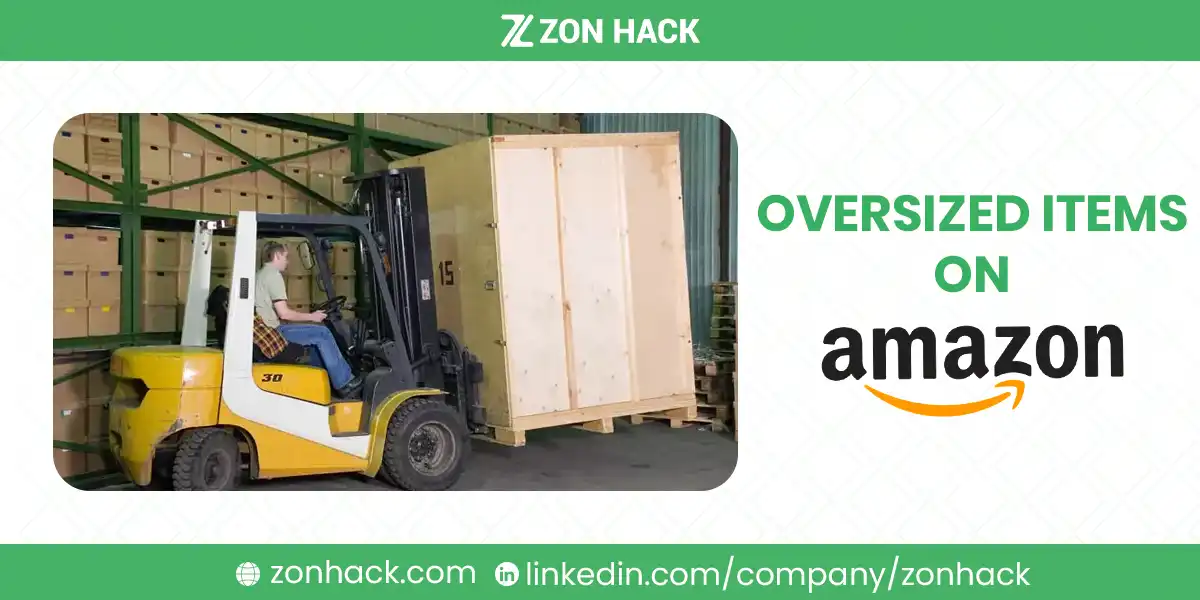
Listing oversized items on Amazon is mechanically the same as listing anything else. What changes is the economics, and it changes sharply. Your product’s size tier is determined by its packaged dimensions and weight, the tier sets the fulfillment fee, and the fee bands step rather than slope. A single inch or ounce across a boundary can move the fee by more than your margin.
So the first thing I’d do with a big product is not write the listing. It is to measure the box and find out which side of the line you are on.
How Amazon decides the tier
Amazon measures your packaged product, not the product. Three numbers matter: the longest side, the median side, and either the actual weight or the dimensional weight, whichever is greater.
Dimensional weight is the one people forget, and I’ve found it accounts for most of the nasty surprises. It is calculated from volume rather than mass, so a light but bulky item gets charged as though it were heavy. A pillow and a dumbbell can land in the same fee band.
Amazon also uses length plus girth, calculated as the longest side plus twice the sum of the other two. That measure catches long thin items that would otherwise slip through.
The tiers run roughly like this, and the names have changed over the years:
| Tier | Rough boundary | What it means for you |
|---|---|---|
| Large standard | Up to about 18 x 14 x 8 in, 20 lb | Normal fees. Stay here if you possibly can |
| Large bulky | Longest side to about 59 in, 50 lb | First real step up in cost |
| Extra-large, 0 to 50 lb | Beyond large bulky | Higher fees, fewer fulfillment centers |
| Extra-large, 50 to 70 lb | Heavier | Higher again |
| Extra-large, 70 to 150 lb | Heavy | Specialist handling |
| Extra-large, 150 lb and above | Very heavy | Often not worth FBA at all |
I’d treat those boundaries as approximate and look up the current numbers in Seller Central before pricing anything. Amazon restructured these tiers within the last few years and adjusts the fees at least annually.
What actually changes at oversize
Five things, and in our experience they compound rather than adding up.
Fulfillment fees step up hard. Not gradually. The jump from large standard to large bulky is the one that catches most sellers.
Storage costs more, and much more in Q4. Storage is charged per cubic foot, so a bulky product pays for its volume every month it sits. The fourth-quarter rate is substantially higher, which turns slow oversize inventory into a genuine liability rather than an annoyance.
Long-term storage surcharges bite harder. Same reason. Volume.
Fewer fulfillment centers handle the product. That affects where inventory can sit, which affects the delivery date buyers see. Delivery speed affects conversion. Conversion affects ranking. So this is not purely a logistics matter. Our guide to Amazon product ranking factors covers that chain.
Returns cost more. A returned oversize item costs more to ship back, more to inspect, and is more likely to arrive damaged.
The measurement discipline that saves money
This is the practical part, and I’d do it carefully rather than quickly.
Measure the box you will actually ship. Product inside, packing material in place. Not the product. Not the box flat. The sealed, ready-to-ship package, measured at its widest point, and I’d do it twice.
Then round up. Amazon rounds up, and cardboard bulges. In my experience a package measured at exactly the boundary lands on the expensive side of it often enough that you should assume it will.
Then ask the obvious question: can the packaging get smaller? A redesign that takes half an inch off the longest side can move you down a tier, and that saving repeats on every single unit for the life of the product. I’d spend real effort on this before accepting a tier, because it is one of the few optimizations that compounds automatically.
Things that genuinely work: denser packing material, a snugger box, disassembling the product so it ships flat, and removing the retail box inside the shipping box where the category allows it.
When FBM beats FBA on big products
The default assumption is FBA. On oversize, I’d test that assumption rather than inherit it.
FBA charges you for volume every month and for handling on every order. Both scale with size. If you ship a small number of large units, your own arrangement with a regional carrier can beat Amazon’s fee, particularly if you already hold the stock somewhere.
The trade is the Prime badge and the delivery promise, which matter. But on large items buyers are often less delivery-sensitive than they are on small ones, because they expect a big thing to take longer.
I’d model both before committing. Take your monthly unit volume, calculate the FBA fulfillment plus storage, then get an actual quote for shipping the same units yourself. The answer is not obvious in advance, and in our experience it flips somewhere around the large-bulky boundary for lower-volume products.
If you do go FBM, the performance metrics become your responsibility, and oversize shipments are exactly where late deliveries happen. Our guide to Amazon FBM shipping requirements covers the metrics you have to hold.
Listing details that matter more on oversize
The listing itself needs a few things a small product does not, and I’ve found each one pays for itself in returns avoided.
Dimensions in the bullets, not just in the attributes. Buyers of large items are checking whether it fits somewhere, and they will not dig through the specification table to find out.
Assembled versus boxed dimensions, both stated. Confusing these is a leading cause of returns on furniture and equipment.
Weight stated plainly, because it determines whether one person can handle it.
A scale reference in an image. Something recognizable next to the product. This single image prevents more size complaints than any amount of copy.
Assembly requirements said up front. If it needs two people or a tool, say so. A buyer surprised by that returns the item, and an oversize return is expensive.
Every one of those reduces returns, and on an oversize product a return costs several times what it costs on a small one. I’d treat return prevention as the main job of an oversize listing rather than persuasion.
The arithmetic, worked through
Numbers make this concrete in a way the tier table does not, so here is the shape of the decision.
Take a product selling at $89, 22 lb packaged, just inside a bulky tier. The referral fee takes roughly $13. The fulfillment fee is a significant multiple of what a 1 lb product pays. And storage charges you monthly for the volume whether or not it sells.
Now compare it against a $29 product weighing 1 lb. The referral fee takes about $4.35 and the fulfillment fee is small. The oversize product has to clear all of its extra costs before it starts outperforming the small one, and on a per-unit-of-capital basis it frequently does not.
That is the real case against oversize as a first product. Not that the fees are high, but that the fees plus the freight plus the capital per unit all rise together while the price often does not rise proportionally.
Where the numbers do work, they work because of something specific. A genuinely higher price point, typically well above $100, which absorbs the fees. Or noticeably weaker competition, because the barriers deterred the casual sellers who flood small-product categories. Or a real logistics advantage, such as a supplier close to you or existing warehouse space.
I’d want at least one of those three to be clearly true before committing. If none of them is, the same capital put into two or three small products will almost certainly return more, and it spreads the risk across several bets rather than one large one.
The other number worth running is months of cover. Storage charges accrue monthly on volume, so an oversize product that sells through in six weeks behaves completely differently from one that sits for six months. In our experience sellers model the fee and forget the duration, and duration is what turns a workable oversize product into an expensive one.
Whether to sell oversize at all
Honestly? Harder than small products. I’d not choose it for a first launch.
The fees are higher, the capital tied up per unit is larger, storage punishes you for slow movement, returns hurt more, and freight from a supplier costs more per unit. The arithmetic that works on a 1lb product frequently breaks at 20lb, which is why size is a disqualifier in our product research checklist.
Where it does work, it works for specific reasons. Genuinely less competition, because the barriers deter casual sellers. Higher price points that absorb the fees. A real logistics advantage. Those are real opportunities, and I’ve seen them pay well. They are just not beginner opportunities.
FAQ
What counts as an oversized item on Amazon?
Anything whose packaged dimensions or weight exceed the large standard tier, roughly 18 x 14 x 8 inches and 20 lb. Above that, products fall into large bulky and then several extra-large tiers by weight. Amazon measures the sealed shipping package, not the product itself.
How are Amazon oversize fees calculated?
From the size tier, which is set by the longest side, the median side, length plus girth, and the greater of actual or dimensional weight. Dimensional weight is derived from volume, so a light bulky item can be charged like a heavy one. The fee bands step rather than slope.
Why did my product move into a more expensive size tier?
Usually because the packaged measurement crossed a boundary, often after a packaging change or because the box bulges when filled. Amazon measures the sealed package at its widest point and rounds up, so a product measured at exactly the boundary typically lands on the expensive side.
Is FBA or FBM better for oversized items?
It depends on volume. FBA charges for volume monthly plus handling per order, and both scale with size, so a low volume of large units can be cheaper to ship yourself. Model both against real carrier quotes, since the answer often flips around the large-bulky boundary.
How can I reduce Amazon fees on a large product?
Shrink the package. Taking half an inch off the longest side or a pound off the weight can drop a tier, and that saving repeats on every unit for the life of the product. Denser packing, a snugger box, shipping flat-packed, and removing an inner retail box all work.
Do oversized items have higher return costs on Amazon?
Yes, considerably. Return shipping costs more, inspection costs more, and large items arrive damaged more often. That is why an oversize listing should be built primarily to prevent returns, with dimensions, weight, assembly requirements and a scale image all stated clearly.
Last updated: September 12, 2026. Amazon’s size tier boundaries, fulfillment fees and storage rates change at least annually and differ by marketplace, so confirm current figures in Seller Central and against Amazon’s seller documentation before pricing a product. ZonHack is an Amazon Ads verified partner and an Amazon SPN Verified Partner.