
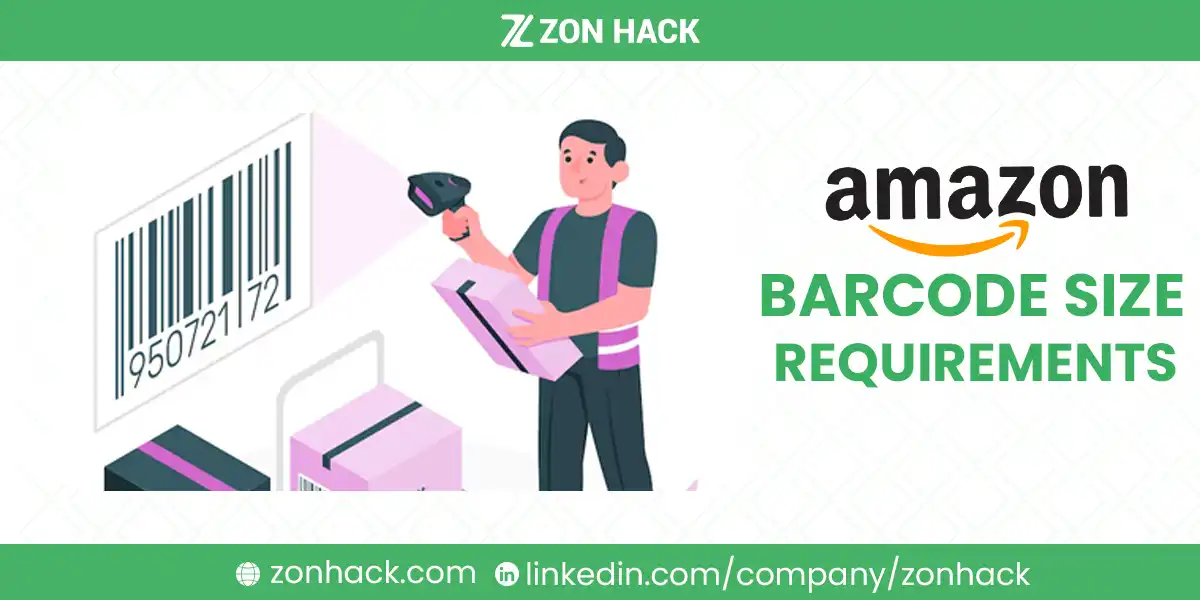
Amazon barcode size requirements come down to a few hard numbers: item labels between 1 x 2 and 2 x 3 inches on white stock, barcode height at least 0.25 inches (and no less than 15% of the barcode’s length), quiet zones of 0.25 inches at the sides and 0.125 inches top and bottom, and 300 dpi thermal printing as the reliable standard.
This is the spec sheet: every measurement, printer setting and material rule in one place, plus the failure patterns that get inventory rejected at check-in.
Before the numbers, the question that comes first: which barcode does the unit need? The short answer is below, and our companion guide to Amazon barcodes explained has the long one.
We prep and label client inventory routinely, so the specs below are the ones we actually print against, not just Amazon’s documentation repeated.
Which barcode does your product need?
Three options, and the choice is usually made for you by how you are selling rather than by preference.
| Barcode | When it applies | What you print |
|---|---|---|
| FNSKU | The default for FBA. Amazon’s own identifier, unique to your listing | An Amazon-generated label per unit, covering any existing barcode |
| Manufacturer barcode (UPC or EAN) | Stickerless, commingled inventory, in eligible categories only | Nothing extra. The product’s existing retail barcode is used |
| Transparency | Brand-enrolled products in the Transparency program | Program-issued codes applied per unit |
Most sellers print FNSKU labels, and I’d default to it unless you have a specific reason not to. The rest of this page is written for that case. If you are unsure which applies to a given ASIN, Seller Central tells you at the point of creating the shipment.
The commingled trade is worth understanding before choosing it, and in our experience it is agreed to far too casually. Using the manufacturer barcode means Amazon may fulfill your order from another seller’s identical stock, and theirs from yours. It saves the labeling step. It also means a counterfeit somewhere in the pool can become your inauthentic complaint. I’ve found that sellers who have been through one never go back to it, and I would not recommend it to anyone holding a brand they care about.
A UPC is not a substitute for an FNSKU. The two answer different questions: the UPC identifies the product globally, the FNSKU identifies your units in Amazon’s warehouse. Our guide to Amazon UPC codes covers the identifier side.
Item (FNSKU) label size requirements
The label itself:
| Spec | Requirement |
|---|---|
| Label size | 1 x 2 inches minimum, up to 2 x 3 inches |
| Stock color | White, non-reflective. Off-white fails scanners more than you would guess |
| Adhesive | Removable, so labels peel without damaging the product |
| Print method | Thermal preferred; laser acceptable; avoid inkjet |
We standardize on 1 x 3 inch labels across client prep: enough room for the barcode, the product name line, and the condition note, at commodity label pricing.
The barcode printed on that label:
| Spec | Requirement |
|---|---|
| Minimum height | 0.25 inches (6.3 mm), or 15% of barcode length, whichever is greater |
| Quiet zones | 0.25 inches (6.4 mm) blank at left and right; 0.125 inches (3.2 mm) top and bottom |
| Narrow element width | 13.33 mils at 300 dpi; 20 mils at 200 dpi |
| Wide-to-narrow ratio | 3:1 |
Worked example, because the height rule confuses people: a 3-inch-long barcode needs to be at least 0.45 inches tall (15% of 3 inches beats the 0.25-inch floor). A 1.5-inch barcode only needs the 0.25-inch minimum, since 15% of 1.5 is 0.225, below the floor. Whichever number is larger wins.
The quiet zones are the spec sellers skip most, in my experience. The blank margins are not wasted space; they are how the scanner finds the code’s edges. A barcode crowded by text or trimmed to the label edge reads as damaged even when the bars themselves are perfect.
Text on the label
Use a monospaced font so characters stay legible at small sizes: Consolas on Windows, Monaco on Mac, Andale Mono on Linux. The human-readable line under the bars matters; when a label will not scan, a receiver keys the code in by hand, and that only works if they can read it.
Shipping label size requirements (carton level)
Box-level labels follow their own spec:
| Spec | Requirement |
|---|---|
| Label size | 4 x 6 inches standard, up to 6 x 8 inches |
| Barcode height | At least 0.5 inches (1.3 cm), or 15% of length |
| Narrowest element | At least 0.0075 inches (0.19 mm) |
| Wide-to-narrow ratio | 3:1 |
| Quiet zones | 0.25 inches sides, 0.125 inches top and bottom |
| Adhesive | Permanent, unlike item labels |
| Placement | Flat surface, never over seams, edges, or tape |
Note the adhesive flip: item labels must be removable, carton labels must not be. Mixing the two label rolls is a genuinely common prep-room error, and I have seen it happen in reverse both ways: product labels that will not come off, and a shipping label that peeled somewhere in Kentucky.
Print carton labels from Send to Amazon at shipment creation and apply the full set (FBA box ID plus carrier label) exactly as generated. Never photocopy labels to save printing; copies degrade the bars below scan tolerance.
Where these barcode standards come from
Worth a short detour, because several of the numbers above are not Amazon’s inventions and knowing that makes them easier to get right.
The symbology is Code 128, a widely used linear barcode standard, and the element-width and ratio rules follow from how that symbology encodes data rather than from any Amazon policy. A scanner reads relative bar widths, so an element printed at the wrong width for your printer’s resolution produces a code that looks correct and decodes wrong.
The quiet zone requirement is universal, not Amazon-specific, and I’d treat it as the least negotiable number on this page. Every linear barcode standard requires blank margins, because that is how a scanner identifies where the code starts and stops. This is the rule sellers break most and the one least likely to be forgiven by a reader.
The 15 percent height rule exists so the scanner has enough vertical signal to read across the code at an angle. A short, wide barcode is readable only when the beam crosses it almost perfectly, which in our experience does not happen on a conveyor.
So the framing I’d hold onto: Amazon’s label sizes are Amazon’s choice, and the barcode specs inside them are general standards Amazon is enforcing rather than authoring. Meeting them tends to make labels scan everywhere, not only at a fulfillment center.
Printer settings that actually matter
- 300 dpi thermal is the standard we hold every client print run to. At 300 dpi, set the narrow element to 13.33 mils; at 200 dpi, 20 mils. Mismatched element width at a given resolution produces bars that look fine and scan badly.
- Print density (darkness): too hot and narrow bars bleed together; too cold and bars break up. Print one test label and scan it with a phone app before running five hundred. Thirty seconds of checking beats a relabeling fee every time.
- Direct thermal vs thermal transfer: direct thermal is fine for FBA inbound timelines; thermal transfer resists fading for stock that will sit in storage for many months.
- Avoid inkjet entirely. Smudged inkjet labels are the single most common scan failure we see on inbound rejections.
The failure patterns that cost money
Amazon’s response to unscannable labels is rejection, delay, or relabeling at a per-item fee. The patterns behind almost all of it:
- Violated quiet zones, from oversized barcodes on undersized labels.
- Smudged or low-contrast print, from inkjet, low density, or worn print heads.
- Labels over seams and curves. The bars distort where the surface bends. Flat panel, always.
- Two visible barcodes. An FNSKU applied without covering the manufacturer UPC leaves the scanner a coin flip. Cover the original completely.
- Shrink-wrap over the label that wrinkles or glares. If poly-bagging, label the outside of the bag or keep the wrap taut and matte.
- Copied or rescaled PDFs. Print Amazon’s label files at 100% scale; a “fit to page” setting quietly resizes the bars and breaks the element-width spec.
None of these require expertise to prevent. They require someone caring at the moment of printing, which is exactly what slips when labeling happens in a rush the night before a shipment. If that person keeps being you at midnight, a prep center does this all day against these exact specs, and supplier-side printing at production is cheaper still.
Quick reference card
For the prep-room wall:
- Item label: 1×2 to 2×3 inches, white, removable adhesive
- Barcode height: max(0.25 inches, 15% of length)
- Quiet zones: 0.25 inches sides, 0.125 inches top/bottom
- 300 dpi thermal, narrow element 13.33 mils, ratio 3:1
- Carton label: 4×6 inches, permanent adhesive, flat surface, no seams
- One visible barcode per unit, UPC covered when FNSKU applies
- Print at 100% scale, test-scan the first label of every run
FAQ
What are Amazon’s barcode requirements?
Item labels run 1 x 2 to 2 x 3 inches on white non-reflective stock with removable adhesive, carrying a Code 128 barcode at least 0.25 inches tall or 15 percent of its length, whichever is greater, with quiet zones of 0.25 inches at the sides and 0.125 inches top and bottom. Carton labels are 4 x 6 inches with permanent adhesive. Print at 300 dpi thermal and never at a scaled size.
Do I need an FNSKU or can I use the manufacturer barcode?
FNSKU is the default for FBA. The manufacturer barcode is permitted for stickerless commingled inventory in eligible categories, which removes the labeling step but means Amazon may ship another seller’s identical units against your orders. Most sellers who have had an inauthentic complaint from commingled stock do not use it again.
What size is an Amazon FBA shipping label?
Carton and shipping labels are 4 x 6 inches as standard, accepted up to 6 x 8 inches, with the barcode at least 0.5 inches tall. Unlike item labels, the adhesive must be permanent, and the label must sit on a flat surface rather than across a seam, edge or tape.
What size should an Amazon FBA barcode label be?
Item labels must be between 1 x 2 and 2 x 3 inches on white stock with removable adhesive. We use 1 x 3 inches as the practical standard: room for the barcode, product name, and condition line at low label cost.
What is the minimum barcode height for Amazon?
At least 0.25 inches (6.3 mm), or 15% of the barcode’s total length, whichever is greater. A 3-inch barcode therefore needs 0.45 inches of height, while a short code only needs the 0.25-inch floor.
What are quiet zones on a barcode?
The mandatory blank margins around the bars: 0.25 inches on each side and 0.125 inches above and below. Scanners use them to locate the code’s edges, so text or trimming inside those margins causes scan failures even when the bars are perfect.
What printer should I use for FBA labels?
A 300 dpi thermal label printer, with the narrow element set to 13.33 mils. Laser works acceptably; inkjet smudges and is the most common cause of rejected labels we see. Always test-scan the first label of a run.
Do Amazon shipping labels need different adhesive than product labels?
Yes, and this trips up prep rooms constantly: item labels require removable adhesive so products are not damaged, while carton shipping labels require permanent adhesive so they survive transit. Keep the two label rolls clearly separated.
What happens if my barcode labels do not meet Amazon’s requirements?
Inventory can be rejected at check-in, delayed, or relabeled by Amazon at a per-item fee. Most failures trace to smudged print, violated quiet zones, labels over seams, or two visible barcodes on one unit, all preventable at print time.
Last updated: August 26, 2026. Label specs and fees change; the FBA labeling pages in Seller Central carry the current requirements for your marketplace.