

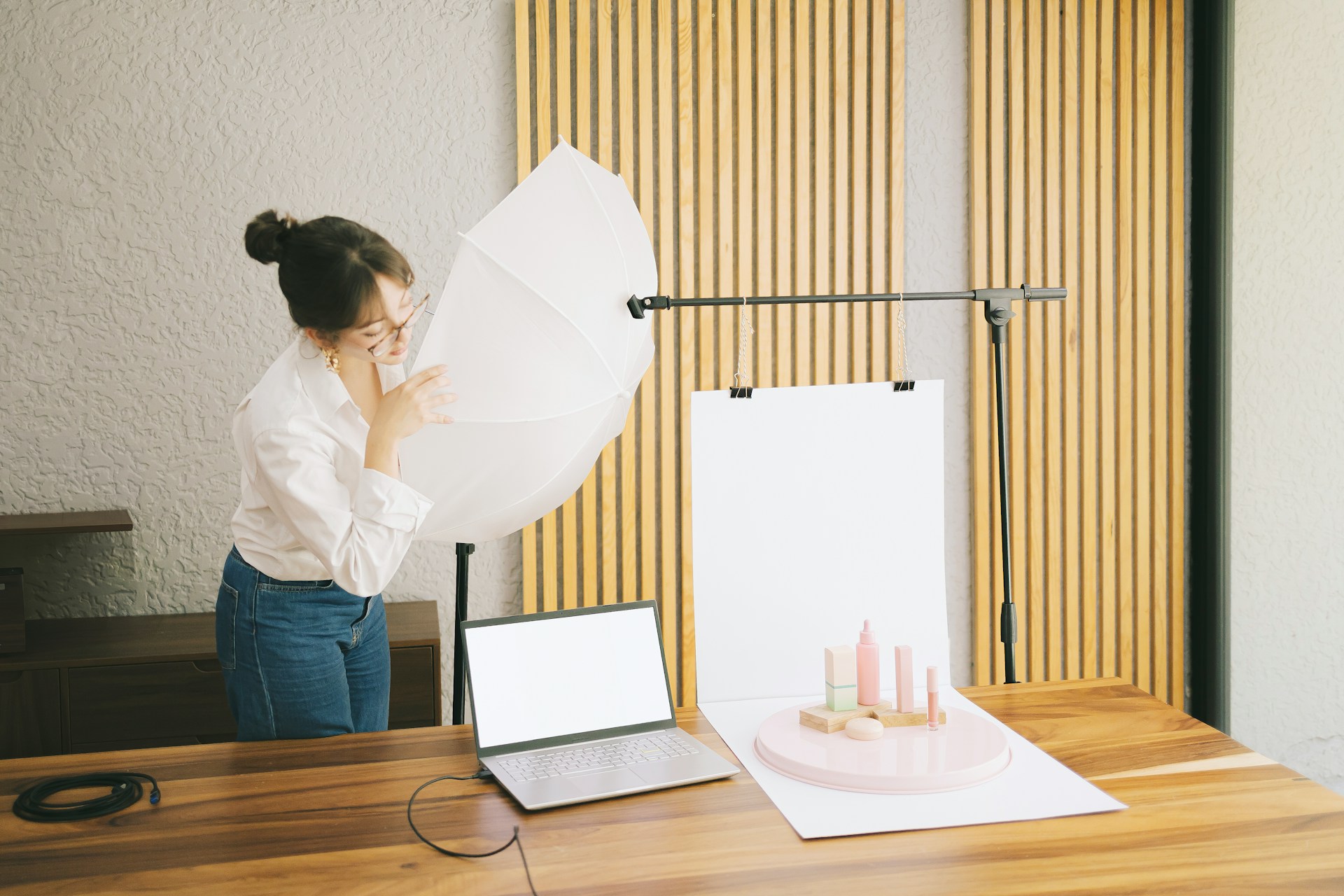
Ecommerce product photography is the set of images that stands in for the physical product when someone shops online, so it decides whether a shopper clicks, trusts what they see, and keeps the item once it arrives. You can shoot it yourself, hire a freelancer, or book a studio. Shopify’s January 2026 pricing guide puts professional work at roughly $50 to $350 per image or $500 to $3,000 per photographer day. My verdict: the cheapest option usually is not the one with the lowest invoice, because poor photos cost you in returns, ad clicks and, on Amazon, listing visibility.
This piece compares the three routes, then puts numbers (where a primary source gives them) on what bad images really cost. If you sell on Amazon and want the shoot and the listing set handled together, our product photography service covers that end to end.
A short framing note first. I’m treating product photography for online stores as one budget line that touches several others: advertising, returns, customer service and marketplace compliance. Looked at that way, the decision gets easier.
Why photos carry more weight online than you think
Shoppers look before they read. In large-scale usability testing, the Baymard Institute found that 56% of users’ first action on a product page was to explore the images (Baymard, in-scale product images). The same research found that 42% of users try to judge a product’s size from its photos, yet 28% of the 60 major ecommerce sites benchmarked offered no image showing the product in scale.
That gap matters. When shoppers can’t judge size, Baymard notes they may wrongly discard a product that would have suited them. And the opposite happens too: a buyer guesses wrong, orders, and sends it back. Baymard didn’t measure returns in that study, so take the second half as my reasoning rather than its finding. Amazon’s own Product image guide makes the same link directly, listing fewer returns “due to mismatched expectations” as one of the benefits of good images.
Quality matters as much as coverage. A separate Baymard study found that 25% of ecommerce sites provide images that are insufficient for visual exploration, because of low resolution or weak zoom (Baymard, image resolution and zoom). Its researchers go further and say low-quality images can be worse than none, since they suggest the seller doesn’t care enough to help.
The hidden costs of poor product photography
None of these costs shows up on a photographer’s invoice. That is why they get ignored. I think of them as a tax. You pay it quietly, every month, until the images change.
1. Returns and the fees attached to them
A product that looks bigger, brighter or more complete online than it is in the box comes back. Each return costs you shipping, handling and often a unit you can’t resell as new. On Amazon it can also cost a fee.
Under Amazon’s returns processing fee rules, apparel and shoes pay a fee on every customer-returned unit. Every other category pays on returned units above a category threshold, measured over the shipment month and the next two months. As of November 2026 the threshold is 8.1% for Home and Kitchen, 5.5% for Beauty, Health and Personal Care, and 4.7% for Toys and Games. The fee for a small standard item of 2 ounces or less is $1.78 per unit over the line. Products that ship fewer than 25 units a month are exempt.
So a misleading photo does not only lose the sale. It can push an ASIN over its threshold and add a per-unit fee to every extra return. Scale shots and accurate color are the cheapest return-prevention tools I know.
2. Paying for ad clicks that never convert
On Amazon, your main image is your ad. Amazon Ads states that Sponsored Products ads show your product title, image and price, so a dull or confusing thumbnail costs you twice: fewer clicks per impression, and weaker conversion from the clicks you do buy. The same logic holds for Google Shopping and Meta catalog ads, which also pull from your product images.
In my view this is the biggest hidden cost for brands that advertise heavily. A poor image doesn’t just sit there. It burns budget every day the campaign runs. Our guide on click-through rate optimization explains how to tell an image problem from a keyword problem.
3. Suppression and lost visibility on Amazon
Marketplaces enforce image rules. Amazon’s main image needs a pure white background (RGB 255, 255, 255) with the product filling 85% of the frame. If no compliant main image exists, Amazon says it may temporarily remove the listing from search. Its image suppression page lists the usual causes: an off-white background, text or watermarks, props, a cropped product, blur, or a product that looks too small.
A suppressed listing sells nothing until it is fixed. For the full list of rules, see our guide to Amazon product image requirements; if a listing is already hidden, resolving suppressed listings covers the steps.
4. Lower conversion on traffic you already have
Every visitor who bounces because the images didn’t answer their question was a visitor you paid for in some way, with ads, SEO work or marketplace fees. Amazon’s own data hints at how much visual content can move sales: its shoppable video guide reports that sellers who added video saw a 24% average increase in sales compared with ASINs without one (Amazon internal data, January to June 2026). That figure is for video, not still images, but it shows the scale of the effect richer visuals can have. Our post on Amazon conversion rate optimization looks at the other levers.
5. Reshoots and lost time
This one hits DIY sellers hardest. A shoot that has to be redone because the color is off, the white isn’t white or the product is too small in the frame costs a second round of time, editing and re-uploading, plus the days the weak images were live. Editing can rescue some of it; our breakdown of Amazon product photo editing costs shows what that work typically involves.
DIY vs freelancer vs studio: how they compare
| Factor | DIY | Freelancer | Studio |
|---|---|---|---|
| Cash cost | Lowest (equipment and your time) | Quoted per image or per day | Quoted per image or per day, often with extras |
| Hidden cost risk | Highest: reshoots, compliance misses | Medium: depends on briefing and marketplace knowledge | Lowest for compliance, higher for minimums and rush fees |
| Consistency across SKUs | Hard without a fixed setup | Varies by person | Usually strong |
| Lifestyle and model shots | Difficult | Possible, often extra | Usual offering, priced as extras |
| Speed for a large catalog | Slow | Moderate | Fastest at volume |
| Best fit | Simple products, early testing | Small catalogs, flexible needs | Large catalogs, launches, brand work |
On pricing, I only trust named, dated sources. Shopify’s product photography pricing guide, published January 27, 2026, says photographers charge anywhere from $500 to $3,000 per day, that per-image pricing lands between $50 and $350, and that rush fees can add 25% to 200% of the job cost. Shopify gives those as market-wide ranges, not separate freelancer and studio bands, so I won’t invent a split. What I’d say is that your quote will sit somewhere in that range depending on complexity, styling, models and how many images you order.
When DIY makes sense
DIY works for simple, rigid products with matte surfaces, such as boxed goods, books, plain homewares and the like. If you can control light, hold the camera steady and check the white background with a color picker, you can produce compliant white-background shots. I’d still budget time for editing and expect at least one round of fixes.
My rule of thumb: if you can’t tell within ten seconds whether your own photo is a phone snap or a pro shot, it’s good enough to test with. If you can tell, so can your buyers.
Where DIY falls apart: reflective items (jewelry, glassware, chrome), apparel that needs a standing model, and anything where texture sells the product. The hidden cost here is your hours plus every week a weak listing is live.
When a freelancer is the better call
A freelancer is my default for a small catalog that needs a mix of white-background and lifestyle images. The quality range is wide, so the brief does most of the work. Ask for marketplace-ready files (RGB, 1,000+ pixels on the longest side for Amazon zoom, true white background), not just pretty photos. Ask to see work in your category, and agree up front on how many retouch rounds are included.
When a studio earns its price
Studios make sense for launches, large SKU counts, and brands that need every product to look like part of one family. They tend to have the sets, lighting and staff to shoot quickly and consistently. Watch for minimums, model and styling fees, and the rush fees Shopify mentions. If your listings are underperforming on images rather than product or price, the higher invoice often pays for itself, but test that rather than assume it.
My verdict
For most marketplace sellers, I’d split the work. Get the main image right first, professionally, because it drives clicks, ad performance and compliance. Then add scale, in-use and detail shots, which is where returns get prevented. DIY is fine for testing a new product. Once an ASIN is selling or you’re spending on ads, poor ecommerce product photography is the expensive choice, not the cheap one.
Honestly, I’d rather see a seller spend on one great main image than on twenty mediocre lifestyle shots. Fix the thumbnail. Then build out.
Measure it, too. Baymard recommends A/B testing on high-traffic products to see the return on better images, and on Amazon you can test a main image directly. Start with your best sellers. That is where the hidden costs are largest.
If you’d like a team to plan, shoot and prepare a marketplace-ready image set, see our product photography service or book a free call.
FAQ
How much does ecommerce product photography cost?
Shopify’s January 2026 guide gives $50 to $350 per image and $500 to $3,000 per photographer day as typical ranges, with rush jobs adding 25% to 200%. Styling, models and editing push the price up.
Is DIY product photography good enough for Amazon?
For simple, non-reflective products, yes, if you can hit a true white background, an 85% product fill and at least 1,000 pixels on the longest side. Reflective items and apparel on models are much harder to get right at home.
What are the hidden costs of poor product photography?
Extra returns and the fees tied to them, wasted ad spend from low click-through, lost visibility if a marketplace suppresses the listing, lower conversion on paid traffic, and the time spent on reshoots.
Do bad product photos increase returns?
They can. When photos misrepresent size, color or contents, buyers are more likely to send items back, and Amazon itself names fewer returns from mismatched expectations as a benefit of quality images.
Should I hire a freelancer or a studio for product photography?
A freelancer suits small catalogs and mixed needs if you write a clear brief. A studio suits launches and large catalogs that need consistent output, though minimums and extras raise the bill.
Which product image should I invest in first?
The main image. It appears in search results and in Sponsored Products ads, and on Amazon it is the image that can get a listing suppressed if it breaks the rules.
Last updated: November 24, 2026. Figures checked on that date against: Shopify, product photography pricing (Jan 27, 2026); Baymard Institute, in-scale product images; Baymard Institute, image resolution and zoom; Amazon returns processing fee; Amazon Product image guide.