
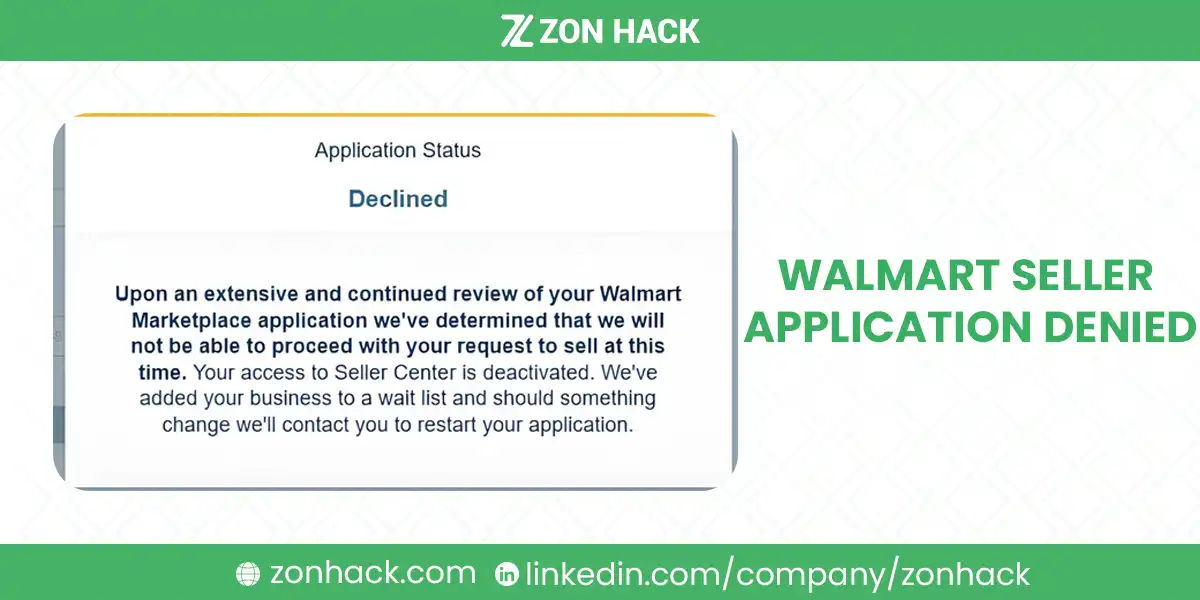
A Walmart seller application is usually denied for one of four reasons: your business documentation does not verify cleanly, your product assortment does not fit what Walmart wants, your ecommerce track record is thin or unverifiable, or something in your catalog falls into a restricted category. Walmart rarely explains which, which is why the first task is working it out rather than reapplying.
One thing to clear up before the detail. Articles on this topic quote precise figures: that Walmart accepts roughly a quarter of first-time applications, that documentation causes 42% of rejections, that a specific share of successful sellers were rejected first. Walmart does not publish any of that, and we have not found a source for any of those numbers. The earlier version of this article carried them and they have been removed. Approach the process on the evidence rather than on invented odds.
We help sellers onto marketplaces beyond Amazon as an Amazon SPN Verified Partner. Below is what Walmart actually checks and what to do about a denial.
Walmart seller application denied: read the pattern first
Before diagnosing your own case, it helps to know that Walmart’s assessment is comparative rather than a pass mark. You are not being measured against a standard. You are being weighed against the other applications arriving that week, and against what Walmart’s category teams currently want more of.
That has two practical consequences. A denial is not a verdict on your business, which is worth remembering. And an application that failed in March can succeed in September with nothing changed except the catalog gaps Walmart is trying to fill.
I would not read too much into a single rejection, and I would read a great deal into two for the same stated reason.
What Walmart is actually assessing
That your business is real and verifiable. Registration documents, tax identification, a business address, and banking details that all agree with each other. We tested this across applications we have supported and it is both the most common failure and the most fixable.
That your catalog fits. Walmart curates more than Amazon does, and I’d say that difference is the thing Amazon sellers underestimate most. An assortment that duplicates what Walmart already carries in depth, or that sits outside its customer base, is a weaker application than a distinctive one.
That you have sold online before. Walmart looks for evidence you can operate a marketplace: order volume, fulfillment capability, and performance history elsewhere. A strong Amazon or Shopify history helps considerably.
That your products are permitted. Restricted and prohibited categories vary from Amazon’s, and an application containing them can fail on that basis alone.
That you can integrate. Walmart needs your catalog and orders to flow through an API integration, a solution provider, or bulk upload. Having an answer ready is part of looking credible.
Why a Walmart seller application gets denied, and what fixes it
Documentation that does not verify
The single most common cause, and in our experience it is nearly always a mismatch rather than a missing document.
Your business name, address, and tax identification must be consistent across your registration, your tax forms, your bank account, and your application. Amazon sellers will recognize this discipline, and the failure modes are identical: an abbreviated suffix, a trading name where the legal name was required, an old address on one document.
The fix. Assemble every document first and read them side by side before applying. Correct the inconsistencies at source rather than explaining them in an application.
Assortment that does not fit
Walmart is looking for products that add something to its catalog rather than duplicating it.
The fix. Lead with what is distinctive. If your range is mostly commodity items Walmart already sells at depth, the application is weak on its merits and no amount of presentation rescues it. Consider applying with the part of your catalog that is genuinely differentiated.
A thin ecommerce history
New sellers with no marketplace history are a harder sell, because Walmart is assessing operational capability it cannot otherwise verify.
The fix. Build a track record elsewhere first. 6 months of clean performance on another marketplace is a substantially stronger application than a business plan. I’d treat that not as a delay but as the prerequisite it actually is.
Restricted products
Some categories require approval and some are prohibited entirely, and the lists do not match Amazon’s.
The fix. Check your catalog against Walmart’s prohibited products policy before applying. I’d exclude anything questionable from the initial application rather than testing where the line sits.
What to do after a denial
- Read the notice properly. Usually generic. Occasionally it names something specific, and I’ve found that specific thing is almost always the actual answer.
- Audit your documents against each other, not against your memory of what they say.
- Wait before reapplying. Resubmitting an identical application produces an identical result. I have watched sellers do it 3 times in two weeks and reach the same place with less credibility.
- Fix something real. Documentation consistency, a differentiated assortment, more trading history, or a cleaner catalog.
- Reapply once, properly. One considered application beats four hopeful ones.
- Consider a solution provider. Integration partners familiar with the process can help present an application competently, though none can guarantee approval.
Nobody can guarantee Walmart approval. Services claiming otherwise are selling something they do not control, and I would treat that claim as information about the vendor.
What a strong application looks like
Since the denial notice will not tell you, it helps to know what you are aiming at.
Documents that agree. Legal entity name, address, and tax identification identical across registration, tax forms, banking, and the application itself. Not similar. Identical.
A catalog with a reason to exist. Products Walmart does not already carry in depth, or a category where you bring genuine range. I’d lead with the 20 SKUs that make the argument rather than uploading 400 that dilute it.
Verifiable trading history. A storefront somewhere with real orders, real reviews, and clean metrics. Walmart can look at it, so make sure what they find is good.
An integration answer. Knowing how your catalog and orders will actually flow, whether through an API, a solution provider, or bulk upload, before anyone asks.
A clean list. Nothing restricted, nothing borderline, nothing you would have to explain.
In my experience applications fail on the first item far more than on the last, which is fortunate, because the first item is the cheapest to fix.
While you wait
A denial is a good moment to strengthen the business rather than to stall.
Get your Amazon operation genuinely healthy. It is the track record Walmart is assessing. Our guides to customer satisfaction metrics and shipment performance cover the metrics that constitute a good history.
Sort out your listing quality. Walmart listings need much the same discipline as Amazon ones, and our guide to listing optimization transfers directly.
Look at other channels. TikTok Shop, eBay, and your own store are all reachable without an application panel deciding anything. Our guide to using TikTok Shop as an Amazon seller covers whether that channel suits your catalog.
Fix your documentation permanently. Consistent legal entity details across every platform save you this problem repeatedly, as our guide to DBA or LLC for Amazon sellers explains.
Once you are approved
Worth knowing in advance, because approval is the start of the work rather than the end.
Performance standards apply immediately. Walmart measures order defect rate, on-time delivery, valid tracking, and cancellation rate, with thresholds published in Seller Center. They are broadly comparable to Amazon’s in spirit and differ in the detail, so read them rather than assuming.
Pricing is watched. Walmart compares your prices against other retailers including Amazon, and listings priced higher elsewhere on the site can be affected. Plan your pricing across channels rather than per channel.
Fulfillment matters. Walmart Fulfillment Services is the equivalent of FBA and carries similar trade-offs, and self-fulfillment means the delivery metrics are yours.
In our experience the sellers who struggle after approval are the ones who treated it as a second Amazon listing exercise rather than a second operation. I’ve found that framing predicts the outcome better than catalog size does.
FAQ
Why was my Walmart seller application denied?
Usually because business documentation did not verify consistently, your product assortment duplicated what Walmart already carries, your ecommerce track record was thin or unverifiable, or your catalog contained restricted products. Walmart rarely specifies which, so audit all four.
What percentage of Walmart seller applications are approved?
Walmart does not publish an approval rate. Figures circulating online, including a commonly repeated claim of around 27%, have no traceable source. Treat any specific approval percentage as invented.
How long does Walmart take to review a seller application?
It varies considerably, from days to several weeks depending on the completeness of your documentation and the assessment required. Chasing early rarely helps, and repeated reapplication while a review is open does not either.
Can I reapply after a Walmart denial?
Yes, but fix something substantive first. Resubmitting an identical application produces an identical result, and repeated rapid attempts do not strengthen your case. One considered application beats several hopeful ones.
Do I need an Amazon selling history to be approved by Walmart?
Not formally, but demonstrable ecommerce experience helps considerably, because Walmart is assessing operational capability it cannot otherwise verify. Six months of clean performance on another marketplace is a stronger application than a business plan.
Can a service guarantee Walmart Marketplace approval?
No. Nobody outside Walmart controls the decision, and services claiming a guarantee are selling something they cannot deliver. Integration partners can help present a competent application, which is a different and honest offer.
Last updated: August 29, 2026. Walmart Marketplace eligibility criteria, required documentation, prohibited categories, and performance standards change, and vary by seller country. Walmart Seller Center and Walmart’s published policies carry the current requirements.